
How AI got into search: a short timeline
We first wrote this post in 2018, when search engines were already giving answers directly on the results page and voice search was growing fast. The direction was right; the pace was faster than anyone expected. The milestones that matter for SEO:
- 2015, RankBrain. Google’s first deep learning system in Search, used to help rank results.
- 2018, neural matching. Better at relating a query to the concepts on a page, not only to its words.
- 2019, BERT. A language model that reads words in context. By 2022 Google said it played a critical role in almost every English query.
- 2021, MUM. A model that both understands and generates language, used for specific tasks rather than general ranking.
- 2022 to 2024, helpful content. A system aimed at content made for search engines rather than people, absorbed into the core ranking systems in March 2024, together with a new spam policy against scaled content abuse.
- May 2024, AI Overviews. Generated summaries at the top of Google results, rolled out to everyone in the US on 14 May 2024.
- October 2024, ChatGPT search. Web search with links to sources, built into ChatGPT.
- May 2025, AI Mode. A conversational search mode in Google, launched in the US on 20 May 2025 without a sign-up.
Keyword stuffing can hurt
As results from SEO tests show, optimizing a text too keenly for keywords can lower its ranking instead of helping it. In the split tests Distilled described on Moz in September 2018, rewriting page titles to target the more commonly searched phrasing led to drops of more than 20% in organic traffic in some tests. This has been known for a long time, but now even a slight effect of artificiality in headlines or content can do more harm than good.
The hours spent meticulously matching keywords to meta tags are gone for good. Google said back in 2009 that the keywords meta tag and the description are not taken into account when evaluating the page: it ignores the first completely and only sometimes uses the second as the snippet. The title still counts, but Google may rewrite it in results. Since August 2021 it builds title links from the visible headline and other prominent text as well as from the title tag. In addition, subpages that do not even contain a given keyword can rank at the top of the results.
The general rule, too much of a good thing will kill you, also applies to text on subpages. For years, agencies including ours advised clients to put a short text on each page describing the subpage. We packed keywords into it and were pleased that we had avoided duplicate content. Such texts, which are not useful to users, can lower rankings. In the same Moz tests, removing a block of keyword-heavy “SEO text” from category pages lifted traffic by 6% on one site, though on another site it caused a small drop, which is why changes like this are worth testing rather than assuming.
The key is usefulness. It has long been known that some subpages show up for keywords they do not contain. Why? Everything rests on the assessment of whether the subpage fulfills its purpose for the user. The algorithm is able to recognize what the page is about and match it to various queries, even ones whose words do not appear on it.
If a subpage shows visible traces of SEO work, it may fall in the rankings. In that case, the only logical option is a complete change of approach to optimization.
Any content on the site should be well thought out. Is it needed at all? Does it bring something new to the topic? Or does it just take up space, written poorly, with keywords bolded for good measure? Google’s algorithm has learned to evaluate the quality of text. We have long seen pages with less content, updated less often, rated better because they provide relevant material.
Is AI content good for SEO?
It can be, and Google has said so in writing. Its guidance from February 2023 says its systems reward original, high-quality content that shows experience, expertise, authoritativeness and trustworthiness (E-E-A-T), “however it is produced”, and that using automation, including AI, with the primary purpose of manipulating rankings is spam. In March 2024 Google extended this into a policy against scaled content abuse: many pages generated mainly to manipulate rankings, whether they were produced by automation, by people or by a mix of both.
Google’s guidance on generative AI adds the practical part. Language models predict likely words rather than retrieve facts, so everything they write has to be fact-checked before it is published, including titles, meta descriptions, structured data and image alt text. The useful reading: AI is fine as a tool for research, structure and drafts, and risky as a replacement for expertise. We describe a workable process in our practical guide on how to use AI for SEO.
SEO as brand building
A similar thing happens with links. We have said for a long time that it is better to focus on obtaining one link from a good, reliable source than on finding dozens of places every month where only medium-quality links can be placed.
Modern SEO requires many more initiatives from our clients themselves. As SEO specialists, we can only advise and suggest. Whenever possible, it is worth taking part in conferences and trade fairs, and sponsoring and partnering with different programs. All of this brings very valuable links, backed by the credibility of the sites that publish them. Not every company has the means or the opportunity to promote itself this way. Our role is to point out such opportunities and the benefits that come from them.
AI answers lean on the same reputations. In Pew Research Center’s analysis of March 2025 Google searches, Wikipedia, YouTube and Reddit together supplied 15% of the sources in AI summaries, close to their 17% share of ordinary results. Real coverage, reviews and expert appearances help a brand get named there, while Google’s own 2026 guide warns that seeking inauthentic mentions across the web is less helpful than it might seem.
A learning algorithm
Google has been fighting artificial optimization for a long time. Any tactic motivated only by climbing the rankings can lead to a fall, especially if it ignores the user’s interest, which comes first. How does the algorithm recognize whether content is relevant or just a simple “SEO text”? How does it judge the reputation of a site?
The answer is artificial intelligence. Algorithms can do much more today than we think. Better processes shorten the time it takes to reach relevant information. In many cases, this simply means skipping the visit to a website. Why open a page if we only want the definition of a word or the weather?
In 2018 that meant featured snippets and direct answers. In 2026 it means AI Overviews, and the effect on clicks has been measured. In Pew’s data, covering 68,879 searches by 900 US adults, users clicked a traditional result in 8% of visits to results pages with an AI summary, against 15% without one, and clicked a link inside the summary in just 1% of visits.
Algorithms also learn how users understand content. Based on many signals, they can determine what a text is about. That is why placing keywords in special spots, or creating a series of subpages for every variant of a phrase, is obsolete. Google really understands what we are trying to say. There is no need to multiply content beyond need. Always think about the user.
What changes when the answer comes from AI
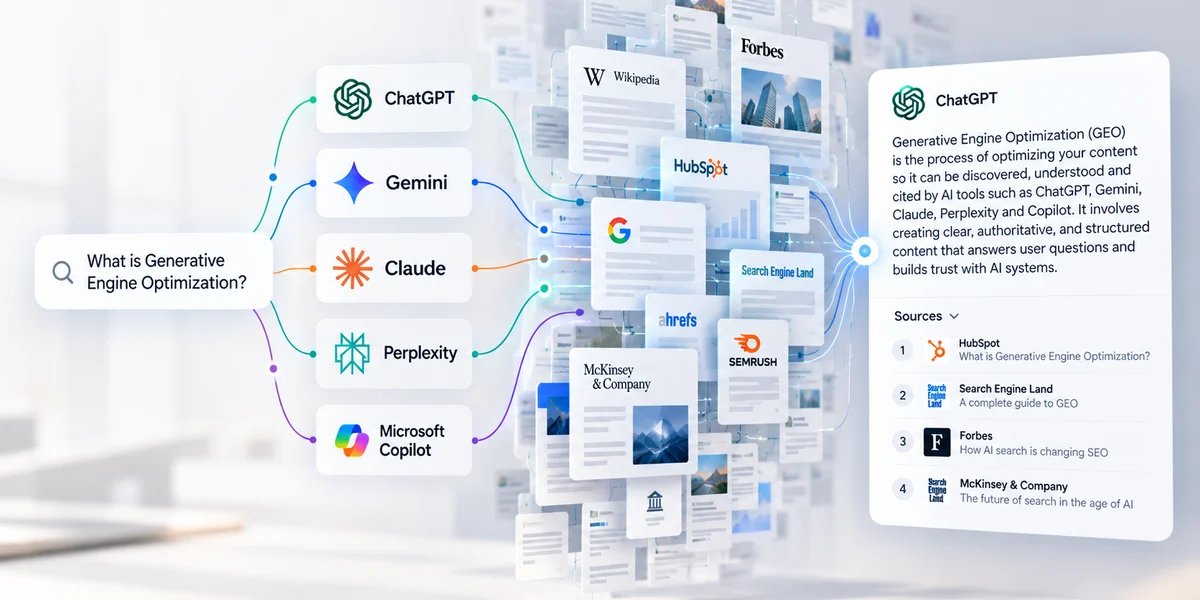
Search is no longer one results page. Google shows AI Overviews and offers AI Mode, and people also search in ChatGPT, Perplexity and Microsoft Copilot. Asking which free AI search engine is best misses the point for SEO: each one picks its sources in its own way, and a site has to be readable by all of them.
Answers are also built from more than one search. Google says AI Overviews and AI Mode may run several related searches across subtopics, a technique it calls query fan-out, and ground the response in pages from its Search index. A page therefore competes for the narrow sub-questions around a topic, not only for the main phrase, which is the same lesson as the 2018 one: cover what the user needs, not the keyword list.
Rankings and citations have drifted apart. Ahrefs found in March 2026 that only 37.9% of the pages cited in AI Overviews also ranked in the organic top 10 for the same query, against about 76% in its July 2025 study. A page on position 40 can now carry the answer, and a page on position one can be left out.
Access has split as well. Each AI company runs separate crawlers for separate jobs: OpenAI uses OAI-SearchBot to surface sites in ChatGPT’s search features and GPTBot to train its models, and each setting in robots.txt works independently. A site that blocks AI bots wholesale may be blocking its own visibility in answers, not only training. Google works differently: its AI features in Search follow the ordinary Googlebot rules, Google-Extended controls use in its other AI systems, and since June 2026 Google has been testing a setting that takes a site out of AI Overviews and AI Mode altogether, at the price of all traffic and impressions from them.
Informational content takes the hardest hit, because a summary can answer a simple question without a click. It does not follow that such content should stop. The summary needs sources, and Google’s 2026 guide says what earns a place: non-commodity content with a unique point of view, such as first-hand experience, rather than information restated from elsewhere. A page that only repeats what ten others say is the one the summary replaces.
The vocabulary grew with it. SEO for AI answers is called generative engine optimization (GEO), answer engine optimization (AEO) or AI SEO, depending on who sells it. Google’s guide for generative AI search, updated in July 2026, says optimizing for it is still SEO. That matches what we see: the four classic kinds of SEO, on-page, off-page, technical and local, all still apply. AI changed their weight, not the list.
What to do about it now
- Check that the crawlers which put you in AI answers can actually read the site, and verify robots.txt rather than assume it.
- Measure impressions as well as clicks. Since June 2026 Search Console has a Generative AI performance report that shows how often your pages appear in AI Overviews and AI Mode.
- Write pages that answer specific questions directly, with sources and numbers inside the text, because AI answers quote passages, not whole pages.
- Build reputation off your site: coverage, reviews, expert appearances and accurate profiles on the reference pages your category relies on.
- Use AI for the work around content, such as research, clustering, audits and first drafts, and keep a person responsible for everything that is published.



 Any questions? Let's talk!
 Write to us,