
Where the term comes from
The name comes from a research paper. In November 2023 researchers from Princeton University and IIT Delhi published GEO: Generative Engine Optimization, later accepted at KDD 2024. They built a benchmark of 10,000 queries, had a language model answer each one from the top five Google results, then rewrote one source at a time and measured how much of the answer it earned. Adding citations to reliable sources, quotations and statistics raised a source’s visibility by 30-40% on their main measure. Keyword stuffing, the reflex of old SEO, gave little to no improvement.
The effect was largest for pages that ranked lower: citing sources lifted the visibility of the fifth-ranked result by 115%, while the top-ranked result lost 30% on average. Treat the numbers as a direction, not a forecast. The answers came from GPT-3.5 in a lab setup, with one test on Perplexity, and today’s engines are different models.
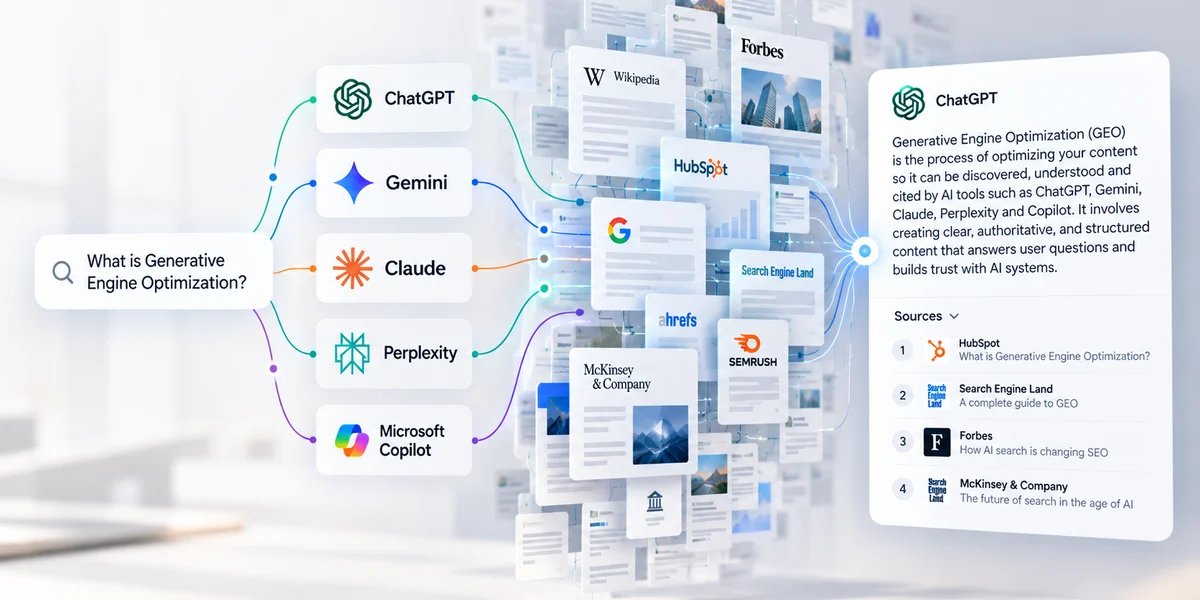
The other names describe the same job from different angles: answer engine optimization (AEO), large language model optimization (LLMO), AI optimization (AIO) or simply AI SEO. Google’s own optimization guide, updated on 10 July 2026, is blunt about the labels: optimizing for generative AI search is optimizing for the search experience, “and thus still SEO.” That is also the short answer to whether SEO is dead now: AI Overviews and AI Mode are built on Google’s core ranking and quality systems, so a page that cannot be crawled, indexed or trusted is not cited either. We cover the longer story of how AI has changed SEO separately.
GEO and SEO: what actually changes
- The unit. SEO competes with pages for positions. An answer quotes passages, so one paragraph that settles one sub-question can carry a whole page into the answer.
- The metric. Rankings and clicks give way to the share of answers that name you, and to which of your pages are cited, for which questions.
- Where the work happens. Part of it is off your site: the reviews, directories, forums and articles the answers already lean on.
- What stays the same. Crawling, indexing, clear structure, real expertise and links from sources people trust. None of it became optional.
The click arithmetic
Pew Research Center analyzed the real browsing of 900 US adults in March 2025, covering 68,879 unique Google searches, of which 12,593 produced an AI summary. On result pages with an AI summary, users clicked a traditional result in 8% of visits, against 15% without one. Clicks on the links inside the summary happened in 1% of visits. Sessions ended on the results page 26% of the time with a summary, against 16% without.
That is the honest baseline for any discussion about AI visibility: the summary absorbs the click more often than it passes it on, and the links it does show are rarely used.
What Google documents about selection
Google’s Search Central guide for site owners, last updated on 10 December 2025, explains the mechanism it calls query fan-out: both AI Overviews and AI Mode may run several related searches across subtopics and data sources, and identify additional supporting pages while the response is being generated, so the links shown can be broader and more varied than a classic results page. The two features may use different models, so their links differ.
On eligibility the guide is blunt. A page must be indexed and eligible to appear with a snippet, and there are no additional technical requirements: no special files, no AI-specific markup, no new schema. The controls are the familiar ones, nosnippet, data-nosnippet, max-snippet and noindex for what can be shown, and Google-Extended for grounding and training in other Google systems. Clicks from AI Overviews and AI Mode are still counted in Search Console under the Web search type, not as a separate channel.
Two things were added in 2026. In June Google launched a Generative AI performance report in Search Console, rolled out to all sites on 31 August 2026: it shows how often your URLs appeared in AI Overviews and AI Mode, by page, country, device and date, but it shows impressions only, no clicks. Google also began testing a control that lets a site opt out of its generative AI features altogether. Sites that opt out get no traffic or impressions from those features, and Google says the setting is not a ranking signal for ordinary results.
The optimization guide adds a list of things you do not need for Google: no llms.txt or other AI text files, no special schema.org markup, no cutting content into small chunks, no rewriting in a special style for AI, and no chasing inauthentic mentions across the web. Structured data still earns rich results; it is just not a ticket into AI answers.
How an answer goes from question to citation
The details differ by product, but the documented pipeline has the same four steps, and each one is a place where a page can drop out:
- Search or not. Not every question triggers a search. A model can answer from what it learned in training, which is how a brand gets named in an answer without any of its pages being linked.
- Fan out. The question is expanded into several related searches across subtopics, so the page that gets used often answers a narrower question than the one the user typed.
- Retrieve and select. Google grounds its answers in pages from its Search index, a method it calls retrieval-augmented generation. Other assistants use their own crawlers and indexes, or a search partner’s results. From what comes back, the system keeps the passages that answer each sub-question.
- Write and attach links. The model writes the answer and links the sources it relied on. Run the same question twice and the list of sources, and of brands, will usually change.
Rankings and citations have come apart
Ahrefs published an analysis on 2 March 2026 covering 863,000 keyword result pages and 4 million AI Overview URLs. Of the pages cited in those AI answers, 37.9% also ranked in the organic top 10 for the same query. In its July 2025 study the figure was about 76%. The rest split roughly evenly: 31.2% came from positions 11 to 100, and 31.0% from beyond position 100. Among cited pages outside the top 100, 18.2% were YouTube URLs.
Two caveats from the authors, both important. Ahrefs improved its parser between the studies, which lets it see more citations, and AI Overviews moved to a newer Gemini model in January 2026. The direction is clear even so: being on page one is no longer a reliable proxy for being quoted, and a page that ranks on position 40 can carry the answer.
Each assistant has its own crawlers, with different jobs
This is where most access problems come from. The crawler that decides whether you can appear in an assistant’s answers is not the crawler that collects training data, and blocking one does not block the other.
- OpenAI: OAI-SearchBot exists to surface websites in ChatGPT’s search features. GPTBot is for training foundation models. ChatGPT-User handles fetches a user triggers and, in OpenAI’s words, is not used to determine whether content may appear in search. Each setting works independently and changes take about 24 hours.
- Perplexity: PerplexityBot is described as designed to surface and link websites in Perplexity search results, and the company recommends allowing it. Perplexity-User serves user-triggered visits and generally ignores robots.txt, because a person asked for that page.
- Anthropic: ClaudeBot collects content that may be used for training, Claude-SearchBot indexes pages to improve Claude’s search answers, and Claude-User fetches pages when a user asks. Blocking ClaudeBot keeps future content out of training; blocking the other two can reduce your visibility in Claude.
- Google: Googlebot’s robots.txt rules govern crawling for Search, and Google-Extended is the separate control for grounding and training elsewhere.
What helps a page get cited, and what does not
Put the evidence together and the list of tactics with real support is short:
- Answers that can be lifted. A direct answer to a specific question, in plain text near the top of its section, because fan-out retrieves passages.
- Evidence inside the text. Named sources, quotations and concrete numbers, the three changes that moved visibility most in the GEO paper.
- Access. The search crawlers of each assistant allowed, and every important page indexed and eligible for a snippet in Google.
- Presence where answers already look. Reviews, directories, reference pages and forum threads about your category, kept accurate.
What does not help: keyword stuffing, which the GEO paper found adds little or nothing; llms.txt files and special markup, which Google says its Search does not use; and manufactured mentions, which Google says are less helpful than they seem, since its core ranking and spam systems apply to AI features too.
What is worth measuring
Positions alone stop being informative here, so the measurement has to change shape. Four things are measurable today without guesswork: the share of answers in your category that name your brand, which of your pages are cited and for which questions, impressions against clicks in Search Console on the pages where an AI answer appears above them, and referral traffic from assistants, which ChatGPT tags with a utm_source parameter.
The free first-party reports come first, because they are the only ones built on real data. Search Console’s Generative AI report gives the impressions. Bing Webmaster Tools has had an AI Performance report in public preview since February 2026, which counts how often your pages are cited in Microsoft Copilot and Bing’s AI summaries and shows the grounding queries behind those citations. That is the practical answer to which GEO tool is best: start with these two, then add a paid tracker for ChatGPT, Claude and Perplexity, and judge it by the size of its prompt set and how often it reruns it. Google’s own warning applies: no third-party tool has access to its internal ranking or AI systems.
Count shares, not positions. In a SparkToro and Gumshoe study published in January 2026, about 600 volunteers ran 12 prompts 2,961 times through ChatGPT, Claude and Google’s AI. For ChatGPT and Google, the chance of getting the same list of brands twice was under 1 in 100, and the same order about 1 in 1,000. The authors’ conclusion is the workable one: visibility measured across dozens or hundreds of prompts, each run several times, is a reasonable metric, and a single ranking position in AI is not.
The sources an answer leans on also differ by platform: Wikipedia, YouTube and Reddit together accounted for 15% of sources in the AI summaries Pew analyzed. That is a reminder that part of AI visibility is earned off your own domain, on the pages the answers already trust.
What this means in practice
Three practical rules follow. Keep the crawlers that surface you allowed, even if you block the ones that train on you, and verify it rather than assume it. Write the pages so the answer to a specific question is extractable in plain text near the top, because fan-out retrieves passages, not reputations. And accept that some of the work is not on your site at all.
This is the job our Digital Intelligence team does: track which brands and pages the assistants quote in a category, fix the technical access, improve the pages the answers rely on, and report the share of answers rather than only rankings. Done properly it is measurement work first and content work second.

 Any questions? Let's talk!
 Write to us,