

SEO professionals spend a lot of effort trying to convince Google that their site deserves a top position, and it is easy to lose sight of the bigger picture: Google’s results come from algorithms that try to understand a conversation.
Algorithms can solve many problems, but matching them to the way people talk is a huge challenge. Their wins in artificial intelligence and machine learning are impressive, and search engines have always been at the forefront of AI. Since its beginnings, Google has been moving search toward natural conversation. A large part of that strategy went under the name of semantic search, then machine learning, and since 2024 generative AI answers.
What is semantic search?
Semantic search refers to the ability of search engines to consider the intent and contextual meaning of search terms when they match content to a query. In simple terms: the engine tries to work out what you mean, not only which words you typed.
At one time, search engines could only analyze the exact wording of a query. Today’s search algorithms are more sophisticated and take semantic principles into account when they evaluate content.
What is the difference between keyword search and semantic search? A keyword, or lexical, engine matches the words of the query to the words of a document, with some help from synonyms. A semantic engine turns the query and the documents into representations of meaning, usually lists of numbers called embeddings, and looks for the closest match, so it can find a relevant page that shares no words with the query. Elastic gives a neat example: “chocolate milk” and “milk chocolate” contain the same words but mean different things.
Is Google a semantic search engine? Partly. Exact words still matter, but since 2018 Google has used neural matching to retrieve pages that describe a concept in different words than the query, and other systems described below re-rank and interpret what it finds. Most large engines work this way, as a hybrid of word matching and meaning matching.
Principles of semantic search
The two primary factors driving semantic search are:
- User search intent. Intent is the reason why someone performs a query, what the user is trying to accomplish. The purpose can be to learn something, to find a specific site, to compare options or to buy. By considering intent, search engines can provide more relevant results.
- The semantic meaning of search terms. Semantics is the study of meaning and of the relationships between words. In search, it refers to the relationship between a query, related words and phrases, and the content of web pages. Taking semantics into account, search engines can show results that are more closely related to the context of the query.
A simple test shows both at work. A query such as “ring” can mean a piece of jewelry, a boxing ring or a video doorbell brand. The engine resolves it from context: other words in the query, the searcher’s location and what most people who type it go on to click.
What does this have to do with search?
The word comes from programming too: computers follow the semantics of a particular programming language, carrying out specific processes and commands.
Semantic features on a website are things like meta tags, headings and the HTML elements themselves. With the rise of the semantic web, search engines have much more metadata to work with.
How does semantic HTML improve SEO? Elements such as header, nav, main, article, section and footer, the h1 to h6 headings, lists and tables tell a machine what each part of a page is: the navigation, the main text, a step in a procedure, a comparison. A styled span can look like a heading, but it has no semantic value. Search engines use the real elements to understand the structure of a page, screen readers use them to guide visually impaired users, and AI systems that split pages into passages find the boundaries more easily.
Almost anything that is related to a query or a site can be considered part of the semantic domain relevant to search results. Semantic search depends both on the semantic markup of web pages and on the vast amount of semantic information from which it must extract meaning.
What is the origin of semantic search?
To understand the history of semantic search, you need to understand the history of search.
When search engines first launched, keywords were the main ranking factor. Typically, the page that repeated the search term most often would get the top spot on the search engine results pages (SERPs).
Semantic search emerged from the semantic web, which is built on ontologies. In computer science, an ontology is a framework of facts and information that make up a knowledge system: which things exist, what properties they have and how they relate. In other words, ontologies allow a system to analyze an input against a network of related facts.
Google brought this idea to search in May 2012 with the Knowledge Graph, which it introduced as a shift to “things, not strings”. At launch it held more than 500 million objects and 3.5 billion facts about them and their relations. By May 2020 Google reported over 500 billion facts about five billion entities, gathered from hundreds of sources, from Wikipedia and licensed databases to structured markup that site owners add to their pages.
Semantic search benefits both users and search engines because it solved two problems:
- It has made it more difficult to manipulate search results with spammy SEO practices, and it has reduced spam and low-quality content.
- It makes search more intuitive, helping users find results that are more relevant to what they are looking for.
Other factors related to semantic search
As search engines keep refining their algorithms, improving results and providing a better user experience, there are several other developments to consider.
Featured snippets and rich results
In 2012, Google introduced the Knowledge Graph to help users “discover new information quickly and easily.” The Knowledge Graph uses semantic search to decipher meaning, which helps users find the information they need as quickly as possible. It was also the beginning of Google’s shift to giving more answers directly in search results. Google now shows content from websites as knowledge panels, rich results and featured snippets to display answers faster and more clearly, and boxes such as People also ask and related searches show which questions it considers part of the same topic.
Hummingbird and RankBrain
Google constantly tweaks its search algorithms to improve the user experience. Publishing updates and adding ranking factors helps increase the accuracy of search results.
In 2013, Google released Hummingbird, a new core algorithm that placed more emphasis on natural language queries and semantic search principles. When Google announced it in September 2013, it said the change affected about 90% of searches.
Then in 2015, Google launched RankBrain, its first deep learning system in Search, which started using artificial intelligence to understand queries and rank top results by connecting words to real-world concepts. Together, Hummingbird and RankBrain shifted search to prioritize user intent and semantics.
Neural matching, BERT and MUM
Since this post was first published, three more systems have taken semantic search further. Neural matching, added in 2018, helps Google match fuzzier representations of concepts in queries and pages.
In October 2019 Google started using BERT, a language model that reads a word in the context of the whole query. At launch Google said BERT would help it better understand one in 10 searches in the US in English, and that 15% of the queries it sees every day are new. Its example was “2019 brazil traveler to usa need a visa”: older systems ignored the word “to” and returned results about Americans traveling to Brazil, while BERT understood the opposite. By 2022, Google said BERT played a critical role in almost every English query.
In 2021 Google introduced MUM, which it described as a thousand times more powerful than BERT and able to work across languages and formats. In 2022 Google said it was used for specific tasks such as improving searches for COVID-19 vaccine information, not for ranking in general. All three are applications of natural language processing: the same field that later produced the large language models behind AI answers.
Voice Search
Another factor affecting semantic search is the rise of voice search. As more people direct their queries to virtual assistants like Alexa and Siri, search engines are evolving to recognize the semantic, conversational nature of these searches.
Voice search typically uses more natural language, longer phrases and more questions. Search engines rely more on semantic search to provide relevant results for these types of searches, and the same conversational style now carries over to AI chats.
AI Overviews and AI Mode
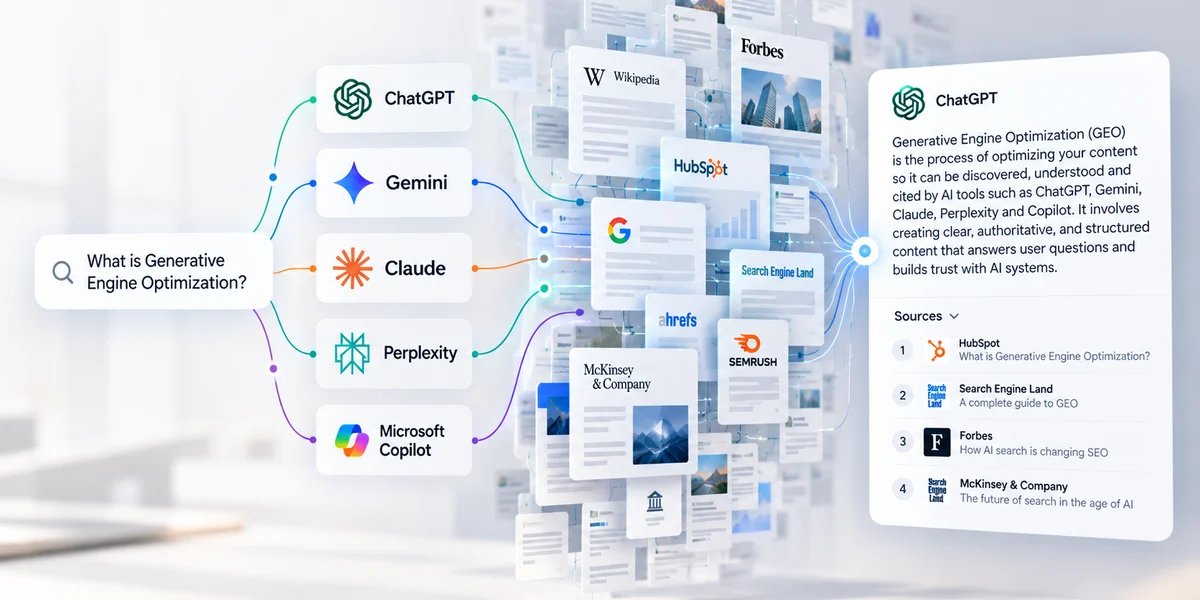
The biggest change since 2020 is generative AI in the results page. Google began rolling out AI Overviews to everyone in the US in May 2024, and AI Mode, a conversational search mode, in May 2025. AI Mode uses a technique Google calls query fan-out: it breaks a question into subtopics and runs many searches at once, then writes an answer from the pages it finds.
This is semantic search taken one step further. The engine no longer only interprets your query, it decides which related questions belong to it and looks for the best passage for each. For a site, that rewards pages that cover the subtopics of a question clearly, in sections that make sense on their own. Google says there are no special requirements or markup for appearing in these features: the same SEO basics apply.
What is the biggest advantage of semantic search?
Semantic search considers user intent and user data.
This is probably the most important thing about it. The best results are not the ones with the most keywords, an optimized H1 and a well-crafted title tag.
Instead, the most relevant page is one that aligns with the user’s intent. From the aggregated data of millions of searches, Google’s machine learning algorithms have learned to interpret what people want.
Google and the other search engines collect huge amounts of data with every query. Fortunately, we can see part of this data in Google Search Console, which shows the queries a page actually appears for, and in Google Analytics 4, which replaced Universal Analytics in July 2023 and shows what visitors do after they arrive.
How to work with semantic search
If you follow current SEO and content marketing practices, you’re probably fine. If you’re still in keyword stuffing mode from 2006, you need to change your plans.
Here’s a shortlist of what to do as a result of semantic search:
All SEO comes down to user experience. The better the user experience, the better your site will do in search engines. This is especially true in the age of semantic SEO and AI answers.
It’s worth knowing as much as you can about the present and the future of internet search.
- Worry less about exact keywords. Search engines understand synonyms and variants, so one page can serve a whole group of queries with the same intent.
- Make sure that any material you create has a clear focus, and state the main answer early.
- Create high-quality content that adds something the pages already ranking do not have: your own data, examples or experience.
- Understand user intentions. Look at what the top results answer: a definition, steps, a comparison or a list of products.
- Don’t fill your content with keywords.
- Cover topics, not single phrases. Answer the related questions from People also ask, and build clusters: a main page for a topic linked with pages for its subtopics.
- Name your entities clearly. Say which company, product, place or person you mean, and describe them the same way across the site.
- Use semantic HTML: real headings in a logical order, lists for steps and tables for comparisons.
- Use structured data tags.
- Focus on long-tail keywords, which reveal intent more clearly than short ones.
- Measure topics, not only positions. Track how a group of related pages performs, since one page now ranks for many queries you never targeted.

 Any questions? Let's talk!
 Write to us,