
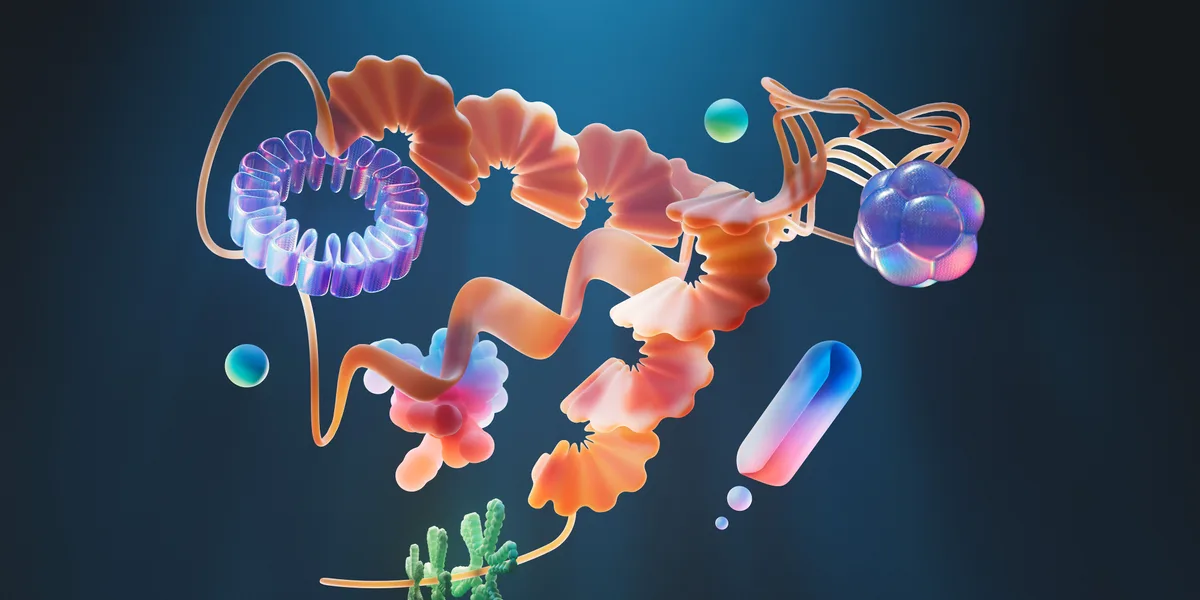
What was published
The paper, Generative design of bacteriophages with genome language models by Samuel King and colleagues at Stanford and the Arc Institute, appeared in Science on 6 August 2026 (DOI 10.1126/science.aec2657), after a preprint in September 2025. The team worked with ΦX174, one of the most studied phages in biology, a small genome of 11 genes.
Of 285 tested designs, 16 propagated and inhibited the intended bacterial strains while leaving unrelated strains alone. They differed substantially from one another, and some performed comparably to their natural relatives. Combinations of them overcame resistance in two E. coli strains.
What Evo 2 is, and what it can do
Evo 1, published in Science in November 2024, was trained on 2.7 million prokaryotic and phage genomes. Evo 2 followed, in Nature on 4 March 2026: a sequence model that takes DNA, RNA and protein as input, built on the StripedHyena 2 architecture, in 1, 7 and 40 billion parameter versions. The largest was trained on 9.3 trillion tokens of genome sequence from across the tree of life, released as the OpenGenome2 dataset, and the two larger versions handle context windows up to a million tokens, enough to read a small genome end to end.
It is used for prediction as much as design: scoring whether a mutation is likely to be harmful, annotating genomes, identifying essential genes, generating sequences. It is free in the sense that matters to a researcher, with code on GitHub and weights on Hugging Face under an Apache 2.0 license, and costly in the sense that matters to a finance director, because the larger versions need recent NVIDIA GPUs and a lot of them. Arc reports over 100,000 model downloads since release.
The step that matters in the phage work is scope rather than scale: previous generative biology mostly designed one protein or one gene at a time, while these designs had to make the parts of a genome work together. The authors call it a proof of concept, and they did not test whether the method extends to larger viruses.
The guardrails are part of the result
Here the safety process deserves as much attention as the headline. Three points from the sources:
- Evo 2 was trained with eukaryotic viruses excluded for safety reasons, so the models had no data on viruses that infect humans, animals or plants. The Arc Institute reports that the exclusion measurably weakened performance on human viruses, and that red-team evaluations found generated sequences effectively random for pathogenic viral proteins.
- The authors consulted safety and security professionals throughout the project, and argue that existing biosafety frameworks can be adapted to generative genomics rather than reinvented.
- A Perspective published alongside the paper, by Thomas Inglesby and Moritz Hanke, makes the policy point bluntly: oversight has to be designed now, while the published work is still restricted to bacterial targets.
Where this could end up mattering
Phages are the reason anyone funds this. Antibiotic resistance keeps narrowing the options for treating bacterial infections, and a phage that can be redesigned when bacteria adapt to it is a different proposition from one that has to be found in nature.
None of this is near a clinic: the sources report no human or animal trials of these designs. For a food producer or a hospital supplier, the right reading in 2026 is that biology is becoming a design discipline, on a timeline measured in years.
What bacteria mean on a production line today
There is a gap worth naming, because it gets blurred in conference talks. AI does not see bacteria on an X-ray image. What inspection AI catches are the physical conditions that let bacteria ruin a product: a packaging seal that does not close, glass cracked under a bottle cap, a foreign body that breaks the cold chain when a tray has to be pulled hours later. That work pays off faster than any biological design program, and in our own food and drink X-ray tests it is what producers ask for: the open and weak seals on a flowpack line, and the cracked glass nobody can see with the cap on.
What this means in practice
Two conclusions. First, if your business touches biology, the useful question is not whether to buy a genome model but whether your data could train one: sequences, assay results, failures included. These models learn from what is published, and what is published is still thin outside a few well-studied systems.
Second, if your business touches food, the practical lever is inspection, not design. Checking every unit on the line for the defects that cause spoilage is a solved engineering problem, and Firecrux X-Ray QC is our answer to it. The biology will arrive later, with regulators attached.

 Any questions? Let's talk!
 Write to us,