
Why predicting pixels is the wrong job
LeCun proposed JEPA in a 2022 position paper, A Path Towards Autonomous Machine Intelligence. The argument is simple: a model that must reconstruct every leaf on a tree spends its capacity on noise, while a model that predicts an abstract description of the scene can spend it on the things that actually matter, such as whether the cup will fall off the table.
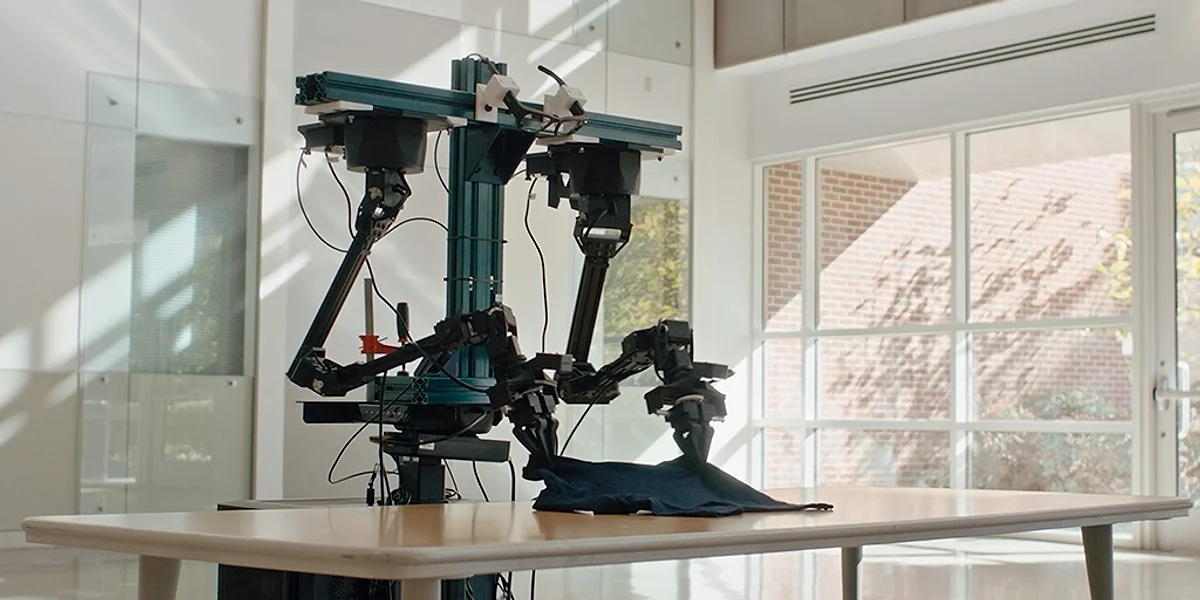
That matters for industry because most physical tasks are prediction problems in disguise. A robot deciding where to put its hand, a vision system deciding whether a seal will hold, a planner deciding whether a line will stall: all of them need a short, cheap forecast of what happens next, not a photorealistic film of it.
How a JEPA works
A JEPA has three parts. A context encoder turns the visible part of the input, for example an image with large blocks masked out, into embeddings. A target encoder turns the hidden part into embeddings too. A predictor then guesses the target embeddings from the context, and the training loss is the distance between guess and target, measured in embedding space. Nothing is ever turned back into pixels.
The hard part is collapse: if both encoders output the same vector for every input, the error drops to zero and the model has learned nothing. Early JEPAs prevented it with tricks, such as a target encoder that is not trained directly but follows a slow moving average of the context encoder.
Is JEPA a transformer? Not by definition: it is a training setup, not a network type. In practice the published models use Vision Transformers for the encoders and the predictor. What differs is the target. Masked autoencoders reconstruct the missing pixels, and methods such as SimCLR or DINO learn embeddings that stay the same across augmented copies of an image, so someone has to choose the augmentations. A JEPA predicts one region’s embedding from another region of the same input, with neither.
From I-JEPA to V-JEPA
Meta published the first working version, I-JEPA, in June 2023. A 632 million parameter Vision Transformer trained in under 72 hours on 16 A100 GPUs, and Meta reported state-of-the-art low-shot ImageNet classification with 12 labeled examples per class, where other methods typically needed two to ten times more GPU-hours.
V-JEPA followed on 15 February 2024. The name stands for Video Joint Embedding Predictive Architecture: the same recipe applied to masked regions of video in space and time. Meta reported training and sample efficiency gains of 1.5 to 6 times and released it under a non-commercial Creative Commons license.
What V-JEPA 2 showed
Meta released V-JEPA 2 on 11 June 2025: a 1.2 billion parameter model pre-trained on more than 1 million hours of video and 1 million images, with no manual annotation. Training ran in two stages, the second one feeding robot control actions to the predictor.
The action-conditioned variant, V-JEPA 2-AC, was trained on under 62 hours of unlabeled robot video from the public DROID dataset. It was then deployed zero-shot on Franka arms in two different labs, with no data collected from those robots and no task-specific reward, and planned toward image goals. Meta reports 65% to 80% success on pick-and-place of new objects in unseen environments. On understanding benchmarks the same model reached 77.3 top-1 on Something-Something v2 and 39.7 recall@5 on Epic-Kitchens-100 action anticipation.
Planning works by search, not by a learned policy. The robot embeds its current camera view and the goal image, the predictor imagines the outcome of candidate actions, and the robot executes the best-rated next action and re-plans at every step. This time the code and checkpoints were released for commercial as well as research use.
The benchmarks published alongside it are the honest part
Meta also released three physical reasoning benchmarks: IntPhys 2 (telling physically plausible video from implausible), MVPBench (pairs of visually similar questions with opposite answers, where you only score by getting both right) and CausalVQA (cause, effect, counterfactuals and anticipation).
Humans score 85% to 95% on all three. Models, including V-JEPA 2, do well on what happened and poorly on what could have happened or what happens next, and on plausibility they sit near chance. Anyone selling you a world model that understands physics should be asked for its IntPhys 2 number.
2026: the recipe got smaller, not bigger
JEPA training used to need a pile of heuristics: stop-gradients, teacher-student copies, schedulers. In November 2025 Randall Balestriero and LeCun published LeJEPA, which argues that an isotropic Gaussian is the optimal embedding distribution for downstream prediction and enforces it with one regularizer, Sketched Isotropic Gaussian Regularization. The result is a single trade-off hyperparameter, roughly 50 lines of implementation, and experiments across more than 10 datasets and 60 architectures. A frozen ViT-H/14 pre-trained on ImageNet-1k reached 79% linear-probe accuracy.
In March 2026 came LeWorldModel (Lucas Maes, Quentin Le Lidec, Damien Scieur, LeCun, Balestriero), the first JEPA the authors say trains stably end to end from raw pixels with only two loss terms: next-embedding prediction and the Gaussian regularizer. Tunable loss hyperparameters drop from six to one. The models are around 15 million parameters, train on a single GPU in a few hours, and the paper claims planning up to 48 times faster than world models built on foundation models. Its latent space also encodes physical quantities and can flag physically implausible events.
The latest JEPA models, as of October 2026
The family kept growing through 2026. The variants worth knowing:
- VL-JEPA (Meta, December 2025) applies the idea to vision-language tasks: it predicts the embedding of the answer text and decodes words only when needed. With the same vision encoder and data it beat standard token training using 50% fewer trainable parameters.
- Causal-JEPA (February 2026) masks whole objects instead of image patches. The authors report about 20 points better answers to counterfactual questions, and planning with 1% of the latent features a patch-based world model needs.
- V-JEPA 2.1 (Meta, March 2026) adds dense prediction losses and joint image and video training, and reports a 20 point gain in real-robot grasping success over V-JEPA 2-AC.
- ThinkJEPA (March 2026) pairs a V-JEPA 2 predictor with a vision-language model that reads frames over a longer span and guides long-horizon prediction.
- H-JEPA (October 2026), from AMI Labs with NYU, INRIA Paris and Brown, builds the hierarchy from LeCun’s 2022 paper: stacked JEPAs, each predicting further ahead in its own latent space, with each level setting subgoals for the one below. On Visual AntMaze three levels raised planning success from 18% for a flat model to 73.3%, with less planner compute. Code and weights are on GitHub under an MIT license.
JEPA vs LLMs and vision-language-action models
An LLM is generative: it predicts the next token of text. A JEPA predicts in embedding space and never has to produce anything a person can read, although VL-JEPA shows the two can meet, with text decoded from predicted embeddings at the end.
The comparison with vision-language-action models (VLAs) comes up because both target robots. A VLA such as Gemini Robotics or pi 0.7 is a policy: it maps camera images and an instruction straight to motor commands, learned from demonstrations. A JEPA world model is not a policy. It predicts what will happen if the robot takes an action, and a planner searches for the actions that reach a goal. The two are converging: pi 0.7 conditions its policy on subgoal images from a world model, and ThinkJEPA borrows a vision-language model to plan further ahead.
The money moved too
On 10 March 2026 LeCun’s new company, AMI Labs in Paris, announced a seed round of 1.03 billion dollars at a 3.5 billion dollar pre-money valuation, co-led by Cathay Innovation, Greycroft, Hiro Capital, HV Capital and Bezos Expeditions, with Nvidia, Samsung, Toyota and Temasek among the other investors. Alexandre LeBrun is chief executive, LeCun executive chairman. There is no product and no revenue yet, and the stated goal is systems built on world models rather than next-token prediction.
Treat the funding as a signal about expectations, not about results. The results worth watching are the small ones: a 15 million parameter model that plans on one GPU is far closer to a production line than a 40 billion parameter video generator.
What this means in practice
Two things follow for anyone running AI on physical processes. First, prediction error in an embedding space is a useful anomaly signal: a model that knows what should happen next can tell you when something does not, without being shown every failure mode in advance. That is the same instinct behind the two-network disagreement check in our X-ray inspection on production lines, where a case that the models disagree about goes to a person.
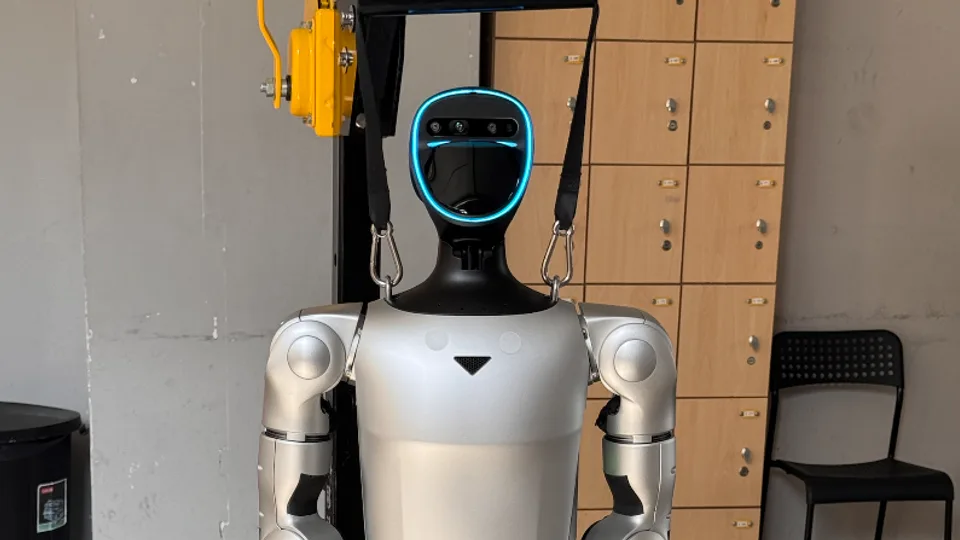
Second, world models are what turn demonstrations into behavior. In our own humanoid robot training we care less about how large a model is than about whether it can predict the consequence of a movement quickly enough to plan the next one. If you have a process where the cost of a wrong action is physical, that is the number to ask about: how far ahead can it predict, how fast, and on what hardware.


 Any questions? Let's talk!
 Write to us,