
Milarex: 99.9% of contaminants caught on X-ray, on lines running 66% faster
Milarex is one of the most modern salmon processing plants in the world. Its old X-ray inspection caught 62% of contaminants such as metal, glass and ceramics, and its false alarms stopped the lines for almost two hours a day. We built the AI that replaced it: Firecrux X-Ray QC went live on the first machine in 2019 and now checks the salmon on every inspection line.
contaminants detected
production line speed
false alarms
trays scanned since 2019
The challenge
Milarex’s previous X-ray system caught 62% of contaminants such as metal, glass and ceramics, and it slowed production down. False alarms ran at about 20% and stopped the lines for almost two hours a day.
The new system had to bring false alarms down to 5% at most and run at least as fast as the old one, so every stage of production stayed in step. It also had to use less energy, because X-ray lamps are costly to replace, and stay flexible as Milarex added new products.
What we built
- Six months of classifying a large image database gave us the training material for deep learning models.
- Two neural networks work side by side: one trained on clean products, one on contaminated ones.
- The models run next to the line, on GPU, CPU or VPU, with the X-ray generators and line-scan detectors already in place.
- Operators mark false alarms and confirmed detections in the scanner software, so the models keep learning. A central server manages every machine and collects the detection statistics.
- Cyclic scanning came first. Continuous scanning followed in 2021, so a contaminated tray no longer stops the line.
How it works
Two models score every tray, and Firecrux X-Ray QC reads the two scores together:
- Clean tray: the model trained on clean products scores highest, and the tray moves on.
- Contaminated tray: the scores reverse, and the tray is rejected.
- Anything unusual, such as a contaminant outside the tested range or deliberate sabotage: the two scores come out close, and the tray goes to a person to check.
Results
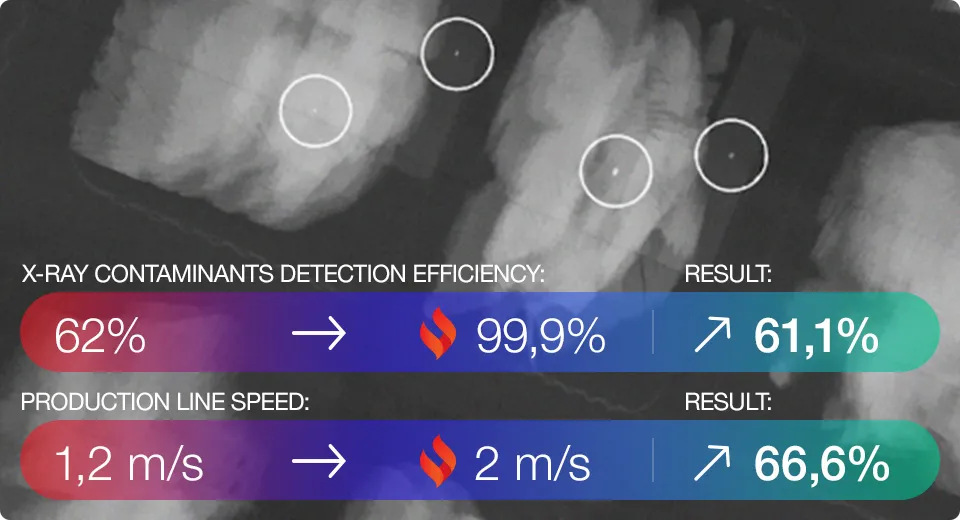
- Contaminants detected: 62% → 99.9%.
- False alarms: from about 20% to under 1%, against a target of 5%.
- Line speed: 1.2 → 2 m/s, 66% faster, which moved the bottleneck of the whole system to another part of the process.
- Over 330 million salmon trays scanned since 2019.
Timeline
- 2017: work on false alarms starts, with real contamination such as broken knife tips, plasters and glass.
- 2019: the first machine goes live, and 13 more follow by 2022.
- November 2022: licensing and maintenance agreements signed. Since then we tune the classification models to keep detection accurate.
- By February 2023: 23.5 million scan cycles, 107,917 detections and about 40,000 trays a day.
- 2025: the inspection stations move to new industrial computers.
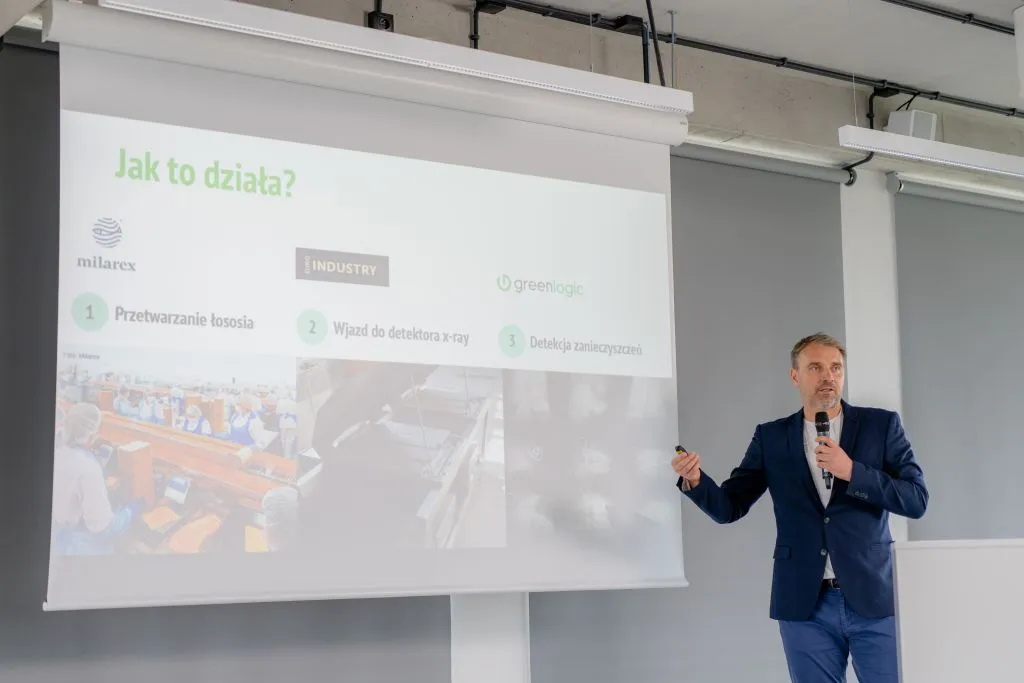
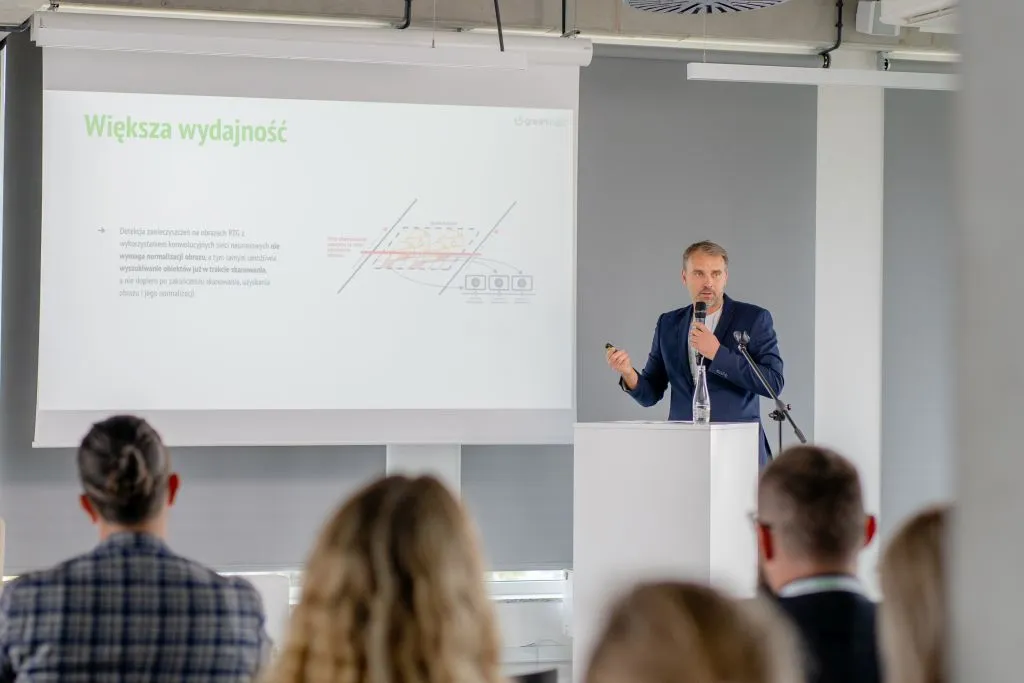
Dobre Mięso 2022: we presented the Milarex X-ray system to the meat industry, from salmon processing and the X-ray scanner to contaminant detection.


Firecrux helped us develop the innovative technology in the industry supporting our food production process. Not only did they understand the problem, but also proposed a solution using machine learning algorithms and successfully implemented it in our factory. We are extremely pleased with the cooperation.Jerzy Malek, CEO of Milarex