

Why anyone is trying this
The Global Research on Antimicrobial Resistance project, published in The Lancet in September 2024, estimated 4.71 million deaths associated with bacterial antimicrobial resistance in 2021, of which 1.14 million were directly attributable to it. Its forecast for 2050 is 1.91 million attributable and 8.22 million associated deaths per year.
Against that, the pipeline is thin. MIT notes that roughly 45 years produced only a few dozen newly approved antibiotics, most of them variants of existing drugs. Known chemistry has been worked over; the interesting molecules are in parts of chemical space nobody has searched.
Six years of AI antibiotics, in four steps
The 2025 result did not come out of nowhere. The field moved from using models to sort known molecules to using them to propose new ones, and each step is a published, checkable experiment:
- 2020, halicin. A model trained on about 2,500 molecules, roughly 1,700 approved drugs and 800 natural products, was pointed at a library of about 6,000 compounds and flagged one that had been investigated as a diabetes drug: the first widely reported AI antibiotic hit, in Cell in February 2020. A follow-up screen of more than 100 million molecules took three days and produced 23 candidates, 8 of them active.
- 2023, abaucin. A McMaster and MIT team tested about 7,500 molecules in the lab, trained a model on the results, and used it to pick out a narrow-spectrum compound that acts on one hospital pathogen and leaves the rest of the microbiome alone, in Nature Chemical Biology.
- 2024, SyntheMol. Stanford and McMaster inverted the problem: a generative model built roughly 25,000 candidate molecules, with the recipes to make them, in under nine hours, from more than 130,000 building blocks. Of 70 ordered, 58 were made and 6 were active, in Nature Machine Intelligence in March 2024.
- 2025, archaeasins. A University of Pennsylvania team ran a deep learning model over 233 archaeal proteomes, flagged 12,623 candidate peptides, synthesized 80, and found 93% of them active against at least one pathogen in vitro, with one matching a last-resort antibiotic in a mouse model. Published in Nature Microbiology in August 2025.
What the 2025 paper actually did
The paper, A generative deep learning approach to de novo antibiotic design, appeared in Cell on 14 August 2025, led by Aarti Krishnan, Melis Anahtar and Jacqueline Valeri in James Collins's lab. Two generative algorithms did the design work: CReM, which makes chemically reasonable mutations, and F-VAE, a fragment-based variational autoencoder pre-trained on over a million molecules from ChEMBL.
The first route started from about 45 million chemical fragments. Machine learning screening cut that to roughly 4 million, then filters for human cytotoxicity, chemical liabilities and similarity to known antibiotics left around 1 million. One fragment was chosen, and the generative models grew it into roughly 7 million candidates, screened down to about 1,000.
The second route generated more than 29 million compounds with no fragment constraint beyond plausible bonding, filtered to about 90.
Two molecules, and the step that nearly stopped the project
Here is the number worth remembering: of the roughly 1,000 computationally selected compounds in the first route, the team picked 80 and sent them to synthesis vendors, and only 2 could actually be made. One of those two was NG1. In the second route, 22 of about 90 were synthesized and 6 showed strong activity against multidrug-resistant Staphylococcus aureus, the best being DN1.
NG1 killed Neisseria gonorrhoeae in a dish and in a mouse model of drug-resistant gonorrhea, and it binds LptA, a protein involved in building the bacterial outer membrane and a target no approved antibiotic uses. DN1 cleared an MRSA skin infection in mice and appears to disrupt membranes more broadly, without a single protein target.
June 2026: the screening model got its own paper
The deep learning model that scored those candidates was published in Science Translational Medicine in June 2026, with Anahtar, Valeri and Majed Modaresi as lead authors and Collins and Donald Ingber as corresponding authors. The team first tested 38,650 small molecules against N. gonorrhoeae to train the model, then ran it over a library of about 6 million compounds and validated 213 candidates.
The lead, an aminothiazole called A1, inhibits alanine racemase, an enzyme bacteria need to build their cell wall, and resistance arose only at very low frequencies. Five doses of A1 within 24 hours significantly reduced bacterial load in a mouse infection model, and a second compound, MP20, lowered pathogen titers in the Wyss Institute's Vagina Organ Chip. The authors are explicit that A1 needs further validation and hit-to-lead optimization by medicinal chemists before it is a clinical candidate.
The context matters: gonorrhea got its first new treatments in decades in December 2025, and Anahtar points out that historically resistance has emerged within 5 to 10 years of a first-line rollout.
Who carries it to the clinic
The compounds moved to Phare Bio, the nonprofit in the Antibiotics-AI Project that Collins co-founded, which received up to 27 million dollars from ARPA-H in September 2024 to advance AI-generated preclinical candidates. On 11 December 2025 Phare Bio announced a partnership with Basilea Pharmaceutica: Phare Bio designs and validates molecules against a target profile agreed in advance, Basilea takes candidates through development and clinical trials, and Phare Bio is eligible for success-based payments. The target is a broad-spectrum antibiotic for high-priority gram-negative infections.
The reason the baton goes to a nonprofit is money, not science. Antibiotics are expensive to develop, sold cheaply, and taken for a week, so a successful one earns far less than a chronic-disease drug, and researchers in the field, including Jonathan Stokes at McMaster and César de la Fuente at Penn, argue that governments and philanthropy have to fund this work as a public health service. No AI-designed antibiotic has been approved anywhere, and as of the sources we could check, none of these candidates has entered human trials. The two drugs that actually reached pharmacy shelves for gonorrhea in December 2025 came from conventional chemistry started years earlier, carried by a public-private partnership. That is the normal shape of drug development, not a failure of the method.
What this means in practice
The transferable lesson is not about chemistry. A generative model turned an unsearchable space into a shortlist, and the bottleneck moved immediately to the physical world: 80 molecules ordered, 2 delivered. Stokes puts the general version of this bluntly: AI is just a pipette. Every serious AI project we run has the same shape. The model narrows the options, and then something slow and real decides, whether that is a synthesis vendor, a production line or an inspector.
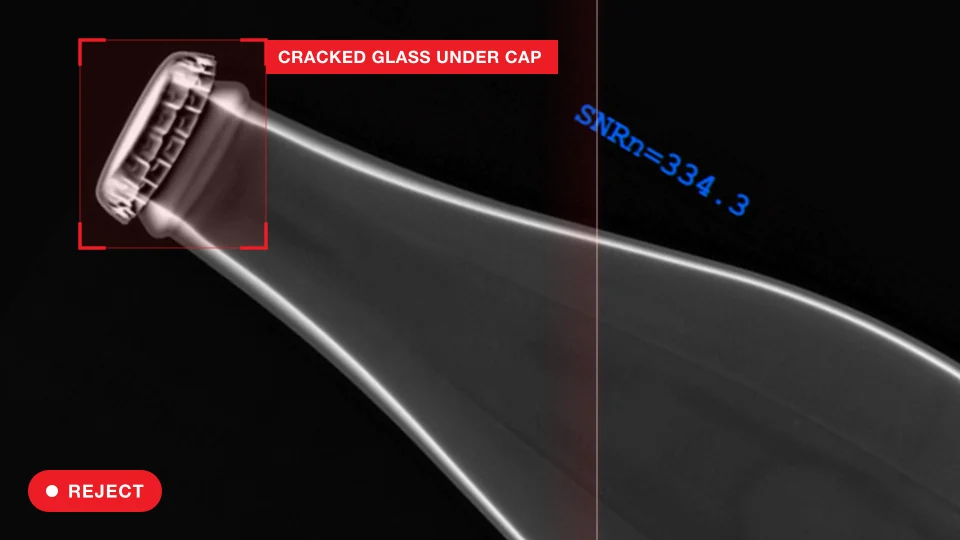
So when you plan an AI project, plan the physical step first. In our own work that means scanning your samples before anything is installed, which is how our X-ray test for Carlsberg ran: you send products with the defect you care about, we scan, label and train, and you get a report on what the model caught and missed. If you want to find the bottleneck in your own process quickly, that is what a two-week proof of concept is for.

 Any questions? Let's talk!
 Write to us,