
What is Go?
Go is a very popular game in East Asia. It is an abstract board game that originated in China more than 2,500 years ago. Two players take turns placing black and white stones on the intersections of a 19×19 grid, trying to surround territory and capture the opponent’s stones. Although the set of rules is very small, it creates a challenge of unusual depth: DeepMind puts the number of possible board positions at about 10 to the power of 170, more than the number of atoms in the universe.
Thanks to the intricacy of Go, human players become experts over years of practice, refining their intuition and learning to recognize patterns. It is played largely by intuition, and with its beauty, subtlety and intellectual depth it has captivated the human imagination for centuries.
Why Go and not chess?
Go is considered far more difficult than chess and other strategy games for a computer. The AlphaGo team put the numbers side by side in its 2016 Nature paper: a chess position offers about 35 legal moves and a game lasts about 80 moves, while a Go position offers about 250 moves over a game of about 150. Searching every line is hopeless, and it is also very hard to write rules that judge who is winning in a Go position. As you know, games are hard to compare, but when it comes to difficulty for AI, Go is at a higher level.
Just to remind you, the AI pioneer Deep Blue beat world chess champion Garry Kasparov in May 1997, 3.5 to 2.5, after losing their first match in 1996. It was a great feat in those days. However, Deep Blue worked on a different basis than today’s artificial intelligence. It relied on raw computing power: 32 processors searched about 200 million chess positions per second and scored them with an evaluation built specifically for chess. Everyone knew that its only goal was to play chess, and its programming could not be reused for much else. AlphaGo combined computing power with something closer to human intuition, learned from data, and this combination can be applied to many other purposes.
How AlphaGo learned
The complexity of Go meant that it had long been seen as the most challenging classic game for artificial intelligence. Despite decades of work, the strongest Go programs played only at the level of good amateurs. Traditional AI methods, which build search trees over all possible positions, had no chance in Go because of the huge number of possible moves and the difficulty of assessing the strength of each board position.
To capture the intuitive side of the game, the developers adopted a novel approach. AlphaGo combines advanced tree search with deep neural networks. These networks take a description of the Go board as input and process it through a number of different network layers containing millions of neuron-like connections. One neural network, the policy network, selects the next move. The second, the value network, predicts the winner of the game. A Monte Carlo tree search uses both to look ahead only along the most promising lines.
The team first trained AlphaGo on 29.4 million positions from 160,000 games played by strong amateurs (6 to 9 dan) on the KGS Go Server, until it predicted the expert’s move in 57% of test positions. It then played against different versions of itself many times, each time learning from its mistakes and gradually improving, through a process known as reinforcement learning. Before playing a human professional, it won 494 of 495 games against other Go programs.
How much did AlphaGo cost? DeepMind has never published a figure. What is public: Google bought DeepMind in January 2014 for a price reported at more than $500 million, and the distributed version of AlphaGo that played in October 2015 ran on 1,202 CPUs and 176 GPUs.
AlphaGo vs the Go masters
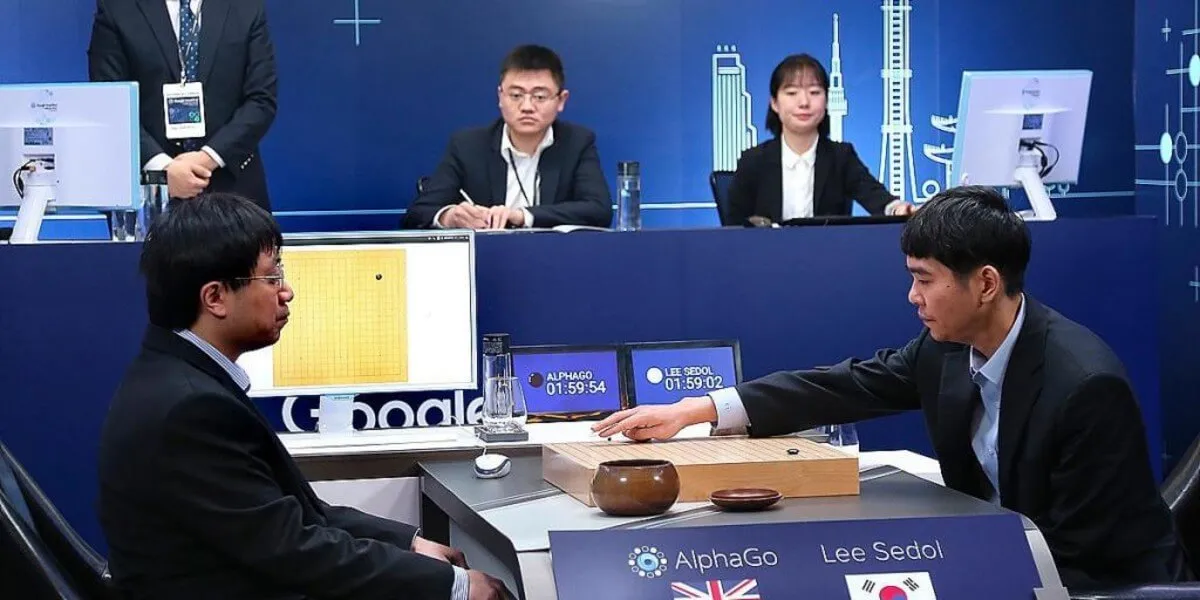
The first official AlphaGo match was against Fan Hui, three-time European champion, in October 2015. AlphaGo won 5-0, the first time a computer program had beaten a professional Go player without handicap on a full board, and the results were published in full technical detail in Nature in January 2016. AlphaGo then took on the legendary Lee Sedol, winner of 18 international titles and widely considered one of the best players in history.
AlphaGo’s 4-1 victory in Seoul, South Korea, in March 2016 was watched by over 200 million people around the world. It was a breakthrough for artificial intelligence and a shock for the whole Go world. AlphaGo played in a highly inventive way. Its move 37 in game two had, by its own estimate, a 1 in 10,000 chance of being played by a human, and commentators first took it for a mistake. Some of its moves overturned centuries of received wisdom and have been studied by players at all levels ever since. In winning, AlphaGo taught the world new knowledge about perhaps the most studied and contemplated game in history.
Has anyone beaten AlphaGo? Lee Sedol did, once. He won game four with move 78, a move AlphaGo had also rated at about 1 in 10,000 and failed to anticipate; it became known as “God’s Touch”. He is the only human who has won an official game against AlphaGo. Because AlphaGo won the match, the $1 million prize went to charities, including UNICEF, and to Go organizations. The 2017 documentary AlphaGo, directed by Greg Kohs, tells the story of the match.
What happened to AlphaGo next? Between December 2016 and January 2017 an improved version played online under the name Master and won all 60 of its games against top professionals, Ke Jie among them. In May 2017, at the Future of Go Summit in Wuzhen, China, it beat Ke Jie, then the world’s top player, 3-0. DeepMind then retired AlphaGo from competitive play. Lee Sedol retired in November 2019, telling Yonhap that even if he became number one, “there is an entity that cannot be defeated.”
AlphaGo Zero: removing human knowledge from the program
Google’s artificial intelligence unit DeepMind presented a newer version, AlphaGo Zero, in Nature in October 2017. Unlike previous versions, which learned from thousands of human amateur and professional games, AlphaGo Zero learned Go simply by playing against itself, starting from completely random play and knowing nothing but the rules. In three days it played 4.9 million games against itself and then beat the version that defeated Lee Sedol 100 games to 0. After 40 days of training it beat Master 89 games to 11. It is a much stronger player than the program that beat the world champion, and more importantly, it is completely self-taught.
AlphaGo Zero is also simpler. It uses a single neural network instead of separate policy and value networks, and it played on one machine with 4 TPUs, Google’s AI chips, where AlphaGo Lee needed 48. According to DeepMind, this brought the company a step closer to general-purpose algorithms that could help with some of the hardest problems in science, from protein folding to reducing energy consumption and searching for new materials.
The difference between AlphaGo and AlphaZero is generality. AlphaZero, published in Science in December 2018, uses the same self-play method with no game-specific knowledge beyond the rules, and learned chess, shogi and Go. It outperformed the chess engine Stockfish after about 4 hours of training and the shogi engine Elmo after about 2, and won 61% of its games against AlphaGo Zero. MuZero, published in Nature in December 2020, went further: it plays Go, chess, shogi and Atari games without being told the rules, learning its own model of what matters in the environment.
DeepMind did not release these systems to the public, but open-source projects such as Leela Zero and KataGo rebuilt the approach and are free to use. They also showed its limits. In research published in 2023, a team at FAR AI found a “cyclic” attack that tricks superhuman KataGo into losing a large group of stones, and amateur player Kellin Pelrine learned the trick and beat KataGo himself. A system can be superhuman on average and still have blind spots.
Meaning for the real world
In 2018, some specialists called AlphaGo a purely academic achievement, irrelevant to the business world. They believed it was more important for people and AI to communicate freely. Despite its complexity, Go, like all board games, is relatively easy for computers to model. The rules are fixed, there is no luck and no hidden information, and, most importantly, researchers have access to a perfect simulation of the game. This means an AI can run millions of trials and be sure nothing is missing. Few real-world fields meet these criteria, which limits where AlphaGo Zero’s method can be applied directly. DeepMind did not create a magic thinking machine.
But the basic technologies behind AlphaGo are important for a variety of industries, such as E-commerce. The key to success is not to memorize a specific sequence of moves, but to recognize patterns and generalize previous experiences.
Eight years on, the results are easier to see. MuZero’s first real-world job, announced in 2022, was choosing compression settings for part of YouTube’s traffic, which cut bitrate by 4% on average at similar video quality. DeepMind’s AlphaFold, built by the lab that made AlphaGo, predicted the structures of some 200 million proteins, and Demis Hassabis and John Jumper shared the 2024 Nobel Prize in Chemistry for it. Earlier, DeepMind had also used machine learning to cut the cooling energy of Google’s data centers. Since 2023 the lab has been Google DeepMind, after a merger with the Google Brain team.
In March 2026, ten years after Seoul, Hassabis wrote that Google DeepMind sees AlphaGo’s search and planning, combined with the world models of Gemini and specialized tools, as part of its path to artificial general intelligence. The move 37 lesson still holds: a system that learns from its own experience can find solutions that people have missed for centuries.

 Any questions? Let's talk!
 Write to us,