
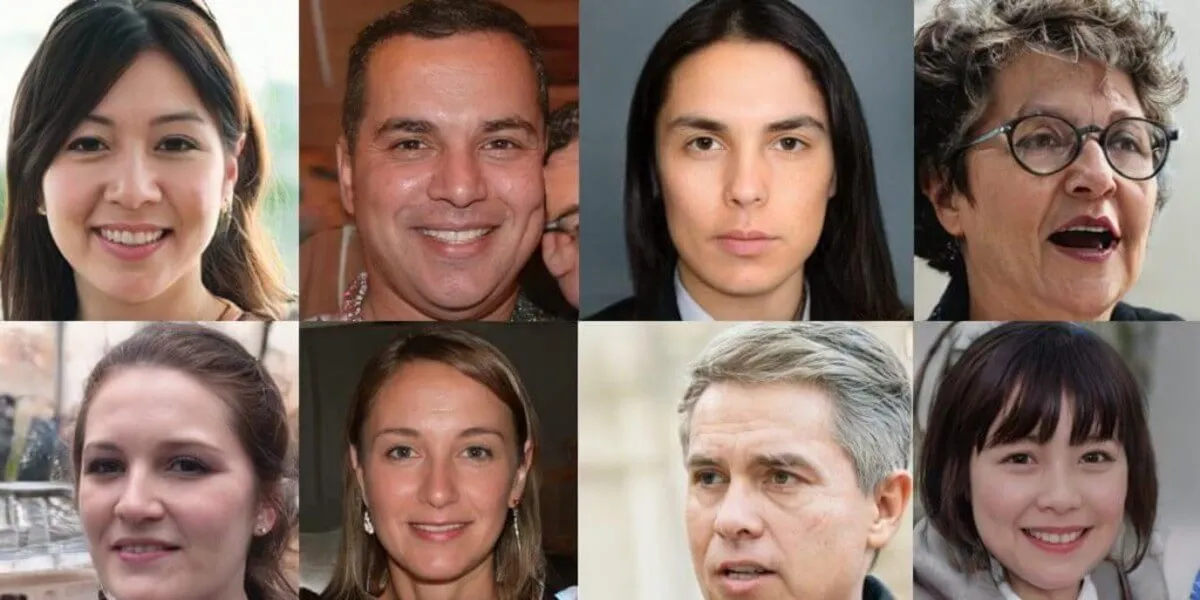
False faces: how GANs generate people
In 2014, machine learning researcher Ian Goodfellow and his colleagues presented generative adversarial networks, or GANs. They have since been used to create everything from graphics to dental crowns.
A GAN consists of two neural networks that compete with each other. The discriminator receives real training images and fakes from the generator and must estimate the probability that each one is real. The generator tries to produce images that the discriminator accepts as real. As both improve, the fakes get better.
An influential early design, the deep convolutional GAN (DCGAN), builds both networks from a convolutional layer structure: small filters, called kernels, are multiplied over groups of pixel values and pick up the edges, shapes and lines in each group.
Progress was fast. Between 2014 and 2018, GAN faces went from tiny, blurry grayscale images to full-color portraits. In October 2017, NVIDIA’s Progressive GAN produced faces at 1024 x 1024 pixels that were already hard to identify as fake.
StyleGAN and ThisPersonDoesNotExist
NVIDIA’s StyleGAN, published in December 2018, was trained on 70,000 photos of real people from Flickr (the FFHQ dataset), varied in age, ethnicity and background. It turns a random code into styles that control the image at each scale: coarse styles set the pose, face shape and eyeglasses, middle ones the facial features, fine ones the color of the eyes, hair and skin. It reproduces glasses, sunglasses and hats, and every new code gives a new person.
In February 2019, software engineer Phillip Wang put StyleGAN behind a website, ThisPersonDoesNotExist.com, which showed a new face on every refresh.
GANs usually learn one category of images at a time, such as faces or cars. BigGAN, from DeepMind in September 2018, was trained on all 1,000 ImageNet categories on a Google TPU pod with up to 512 cores, hundreds of specialized machine learning processors. It more than tripled the previous best Inception Score, a standard measure of image quality.
From GANs to diffusion models
Since 2022, many of the best-known generators use diffusion models, described in their modern form by Jonathan Ho and colleagues at UC Berkeley in 2020. The model starts from pure noise and removes it step by step, guided by a text prompt. Stable Diffusion, released openly in August 2022, needed less than 7 GB of graphics memory, so it ran outside data centers.
That is also how to make AI images of people: describe the age, expression, clothing, lighting and camera angle in the prompt, generate variations and refine one. Typical uses are avatars, website mockups, marketing visuals, game characters and test data. Check the license of the tool and of the model, and never present a generated face as a real customer or reviewer.
Can AI generate real people? Yes, on purpose and by accident. Deepfakes place a real person’s face in a new scene, and Stable Diffusion launched without the filters that kept DALL-E 2 from depicting public figures. In 2023, Nicholas Carlini and colleagues extracted more than a thousand training images from diffusion models, including portraits of real people.
False movements
In 2018, these techniques moved from still images to video, for entertainment as well as misinformation.
Software developed at UC Berkeley and presented in August 2018 as Everybody Dance Now can transfer the movements of one person to another. One part extracts body poses from a source clip; another learns to render the target person in any pose, so it can generate a video of them performing more or less any moves. Its first version needed about 20 minutes of video of the target.
Hollywood animates superheroes, aliens and apes by placing markers on actors’ faces and bodies and tracking them in 3D with special cameras. The Berkeley project suggested that machine learning could bring that production value to anyone. Commercial tools now generate talking presenters, sold as AI humans or avatars, from a script and a photo or a short recording.
Seeing at night, and editing faces in the phone
AI imaging also fits in a pocket. Night Sight on Google Pixel phones, released in November 2018, merges a burst of up to 15 frames to remove noise in low light, then corrects colors with a model trained on photos whose white balance was fixed by hand. Best Take, introduced with the Pixel 8 in October 2023, goes further: it combines several group shots and swaps each person’s face for their best expression from another frame, producing a moment that never quite happened.
How to tell if a face is AI-generated
Human judgment is no longer a reliable test. In a 2022 PNAS study by Sophie Nightingale and Hany Farid, people sorting real photos from StyleGAN2 faces scored 48.2%, no better than a coin toss, and 59% after training. The synthetic faces were also rated 7.7% more trustworthy. A 2023 study in Psychological Science found that white AI faces were judged human more often than real ones, and that the least accurate people were the most confident.
Visual cues still catch weaker fakes:
- Skin that is too smooth or too wrinkled, or looks older or younger than the hair and eyes.
- Shadows around the eyes in the wrong place, and glare on glasses that is missing, excessive or shifting.
- In video, too little or too much blinking, and lips out of sync with the words.
- In StyleGAN portraits, eyes at almost the same spot in every image, because the training photos were aligned the same way.
The stronger check is provenance: a reverse image search, Content Credentials (C2PA metadata that records how an image was made and edited), and invisible watermarks such as Google’s SynthID, which its public detector can read.
Experts are alerting: deepfakes and the rules in 2026
As GANs grew more sophisticated, senior US and British politicians worried about fakes used to spread disinformation or provoke conflict, and researchers began racing to create new algorithms that detect falsified photos and videos. Fakes like these serve propaganda and undermine public confidence in pictorial evidence, which harms both justice and politics.
In 2019, time was still a limit: NVIDIA’s researchers trained StyleGAN for about a week on eight Tesla V100 GPUs. Today a free website makes a convincing face in seconds, so the response has shifted to law and labeling:
- EU: under Article 50 of the AI Act, from 2 August 2026, anyone who publishes a deepfake must disclose that it is artificially generated or manipulated, and providers of generators must mark outputs in a machine-readable way (by 2 December 2026 for systems already on the market).
- US: the TAKE IT DOWN Act of May 2025 covers non-consensual intimate images, AI forgeries included. Since 19 May 2026, platforms must remove them within 48 hours of a valid request.
Experts are also finding ways to authenticate digital images. Early camera apps stamped photos with geocodes to show when and where they were taken. Today the standard is C2PA Content Credentials: Google’s Pixel 10, launched in 2025, signs every photo its camera takes, and Google Photos records AI edits in the same metadata.


 Any questions? Let's talk!
 Write to us,