
What a quadruped robot is, and why four legs
Legged robots come in two main shapes. Bipedal robots, such as Boston Dynamics’ Atlas, walk on two legs like people and have to balance at every step. Quadrupeds walk on four, like dogs. They can lift one leg and still stand on the other three, and stay upright as long as the center of gravity is inside the area between the feet on the ground. Legs, unlike wheels, step over pipes, climb stairs and cross rubble.
Animals are the obvious model. The great advantage of nature is its efficiency: every adaptation that could improve a species’ use of energy was tried, and wasteful variants lost out. We see it in the jumping posture of a cat and in the rhythm and bounce of our own walking. The physical constraints nature has worked with for billions of years apply to robots too.
How Google taught Laikago to walk like a dog
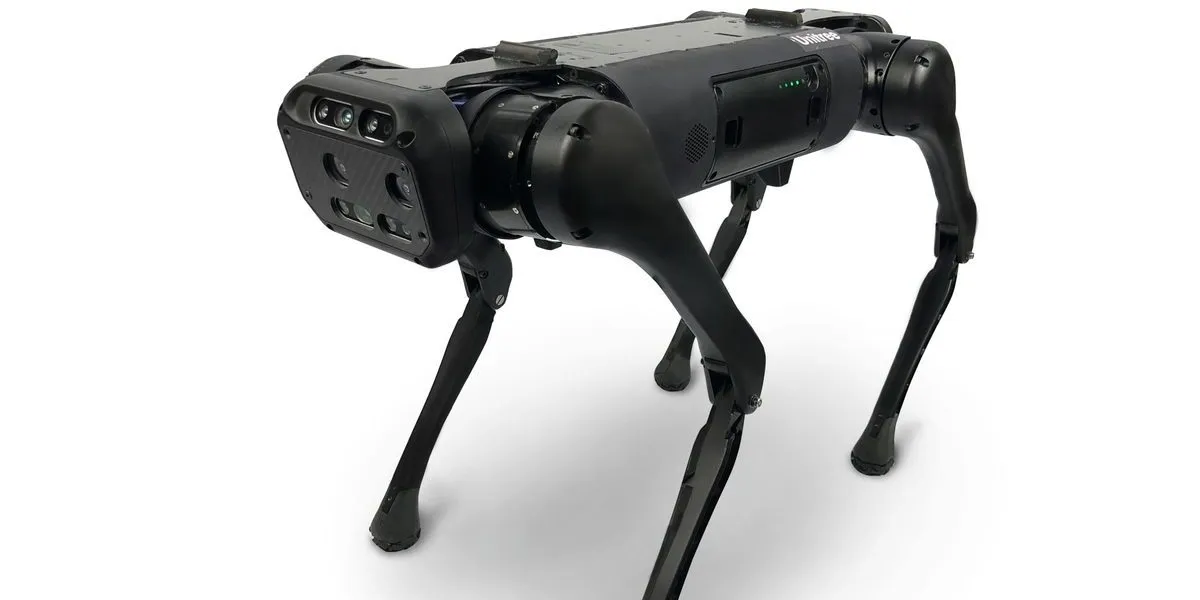
Google’s team took motion capture clips of a real dog from a public dataset and retargeted them onto a digital model of a four-legged robot with a rectangular body and skinny legs. In a physics simulator, the digital robot learned by reinforcement learning to copy those movements. The result was then transferred to a physical Laikago, a robot made by Unitree Robotics and named after Laika, the Soviet space dog.
A robot works very differently from a dog. It has motors instead of muscles and is much stiffer. Still, Laikago learned pacing, a slow gait in which the two legs on the same side move together, and trotting, in which diagonal pairs do. Its learned trot was faster than the fastest gait provided by the manufacturer: 1.08 m/s against about 0.84 m/s. To be fair, it was less stable. It was a first step toward robots that learn to move not through exhaustive coding, but by imitating animals.
Sim to real: getting the gait out of the simulator
The next challenge is to take what the system has learned in simulation and run it on a physical robot. This is sim to real transfer, and it is difficult because a simulation is a simplified version of the world. Mass and friction are modeled as accurately as possible, but never perfectly.
So the Laikago team built not one simulation of the robot but a range of them. During training they randomized the friction, the robot’s mass, motor strength and the delay between sending a command and executing it, so the policy had to work on many slightly different robots. This is called domain randomization. On the real robot, a short search then picked the best setting in about 50 trials of 5 to 10 seconds each.
The system made its most catastrophic mistakes in the simulation, where a fall costs nothing, so the real robot did not have to. Policies trained without randomization failed to transfer for most skills. With randomization and adaptation, the robot moved like a dog despite its different anatomy, down to a spin that looks like chasing a tail it does not have.
Hand-coded controllers and learned ones
Boston Dynamics’ Spot is also modeled on the motion of quadrupeds. In 2020 it climbed difficult terrain thanks to meticulously coded control algorithms, which predict the robot’s next states from a model of its body. The Laikago researchers were frank that learned gaits were not yet as stable as the best hand-designed controllers, and that large jumps and runs were out of reach. They named learning from video clips as a next step.
The gap closed quickly. In October 2020 researchers at ETH Zurich showed an ANYmal controller trained only in simulation that walked through mud, snow and running water it had never seen. In 2021 thousands of simulated robots trained in parallel on one GPU learned to walk on flat ground in under four minutes. In 2024 Boston Dynamics added a reinforcement learning policy, trained across more than a million simulations, to Spot’s locomotion control, and says Spot now falls less on slick surfaces. Atlas, its humanoid, was rebuilt as an electric robot the same year.
Where quadruped robots work in 2026
Quadrupeds are now products. Spot went on sale in June 2020 for $74,500, and Boston Dynamics says more than 1,500 are in customer hands, at companies such as bp and National Grid. The main job is inspection: walking the same route through a plant, substation or building site and collecting data for predictive maintenance. ANYbotics builds ANYmal for power, mining, oil and gas and chemical plants, with zoom and thermal cameras and an ultrasonic microphone. At the other end, Unitree sells its Go2 from $1,600, a price within reach of universities and developers.
Navigating the world of people
Unlike most animals, we want robots to work not only in nature but in the human realm, a world of stairs, doors and narrow corridors. When we build machines for our world, we impose on them the same constraints it imposes on us. As we demand more of them, it should come as no surprise that they start to look more and more like us, whether we copy nature on purpose or design from first principles.
If we want robots to be useful in an environment like the home, they will have to learn much as we do. That will take a large library of movements for robots with legs, and recorded motion of animals and people is one of its richest sources.


 Any questions? Let's talk!
 Write to us,