
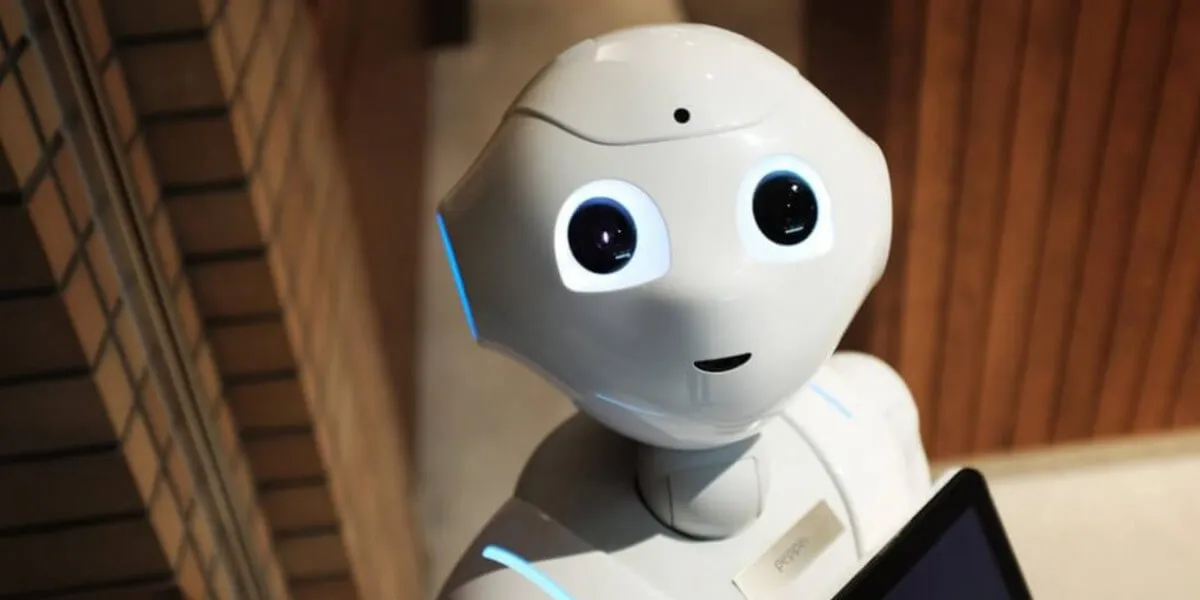
Many people confuse the terms chatbot and AI and use them interchangeably. Although chatbots and AI are closely related, they do not mean the same. Artificial intelligence is the field of building human-like intelligence into machines, and for conversation it mainly relies on Natural Language Processing (NLP) and machine learning.
The confusion grew after OpenAI launched ChatGPT on 30 November 2022. It looks like a chatbot, but behind the chat window is a large language model (LLM), the most capable kind of conversational AI so far. Since then a third term, the AI agent, has joined the mix. To explain the difference well, let’s start from the beginning.
What is a chatbot?
A chatbot is a computer program that imitates human conversation, spoken, written or both. It can follow a script, react to keywords or run on AI. The developers of early chatbots often hoped users would not realize they were talking to a machine. Today EU law requires the opposite: a bot has to say that it is AI.
The history of chatbots goes back to ELIZA, the program Joseph Weizenbaum released in 1966. ELIZA matched patterns in what the user typed and answered from scripts, and it convinced some users that they were talking to a person, because they were ready to attribute human intelligence to answers that only seemed half intelligent. It did not pass the Turing test, which asks whether a judge can tell a machine from a human in conversation. In a 2025 Turing test at UC San Diego, judges took ELIZA for the human in 23% of conversations, while GPT-4.5, told to play a humanlike persona, was picked as the human 73% of the time, more often than the real people it was compared with.
The word chatbot comes from “chatterbot”, the term Michael Mauldin used in his 1994 paper about Julia, a bot he built for the online game TinyMUD.
Problems arise when a chatbot’s limits frustrate customers. The ethical questions researchers have asked from the very beginning, such as whether people should know they are talking to a machine, are still with us, and we come back to them below.
There are four common types of chatbots:
- Menu-based chatbots: the user clicks buttons and the bot walks down a decision tree. Cheap, predictable and fine for a handful of known questions, but of no use the moment someone types a question of their own.
- Rules-based chatbots: one-dimensional bots that react to keywords and follow if-then rules written by people. Technically the code is rather simple, because the bot is built to act on set parameters. Their purpose is to answer known customer requests quickly. However, they cannot learn, and every new case means editing the rules by hand.
- Chatbots based on artificial intelligence: bots that use natural language processing (NLP) and machine learning (ML) to recognize the intent behind a question, however it is worded. Unlike rule-based chatbots, they learn from previous conversations and give customers an almost human touch. They are supported by machine learning algorithms and NLP, make decisions in real time based on past data and understand the client’s context to a certain extent during the interaction.
- Generative AI chatbots: bots built on a large language model that write each answer instead of picking a prepared one. In business they are usually grounded in the company’s own documents, so that they answer from approved content rather than from memory.
What is conversational AI and how does it work?
It helps to separate a product from the technology inside it. Artificial intelligence is software that is good at solving problems independently, which a chatbot as such is not. Cleverly written code is not artificial intelligence unless it uses machine learning algorithms. AI improves a program so that it makes decisions in real time, more accurately and with less human input. Chatbots, on the other hand, are products of the real world, which may or may not contain artificial intelligence.
Conversational AI is the set of AI technologies that let a machine hold a conversation. A typical system has these parts:
- speech recognition, which turns a spoken request into text, for voice channels;
- language understanding, which finds the intent and the details, such as an order number or a date;
- dialogue management, which keeps track of the conversation and decides the next step;
- answer generation, which today is usually a large language model writing the reply;
- retrieval, which first looks up the company’s help articles, policies or account data so that the model answers from them. Researchers at Facebook AI named this retrieval-augmented generation (RAG) in 2020.
Underneath, a language model does not see words the way we do: it reads text as tokens, small pieces of words, which is how machines read our language and why it copes with typos and phrasings nobody planned for.
In terms of personalized experience, AI-based bots clearly beat ordinary chatbots, because they work out what the user means and in what context, which gives better results. A bot built on artificial intelligence can be adapted to an individual store, so it handles questions that stray from the norm. Connected to the customer record, it can also store what it learns in each interaction and find it again when it is needed.
Voice assistants are conversational AI too, which answers a common question: Siri is not a simple bot but an AI assistant. So is Bank of America’s Erica, launched in 2018, which by August 2025 had passed 3 billion client interactions with nearly 50 million users and was averaging more than 58 million interactions a month. ChatGPT, Claude and Gemini are general-purpose conversational AI with a chat window on top.
Chatbot vs conversational AI: the key differences
In practice, these are the differences that matter:
- Understanding: a scripted chatbot recognizes buttons and keywords; conversational AI recognizes intent, follow-up questions and context, in many phrasings and languages.
- Answers: a chatbot returns answers someone wrote in advance; conversational AI composes them, ideally from approved content.
- Learning: a chatbot changes only when someone edits its rules; conversational AI improves with more data and better content, although it does not learn by itself between updates unless it is built to.
- Channels: chatbots mostly live in a website widget or a messenger; conversational AI also works by voice, and across channels with the same knowledge.
- Maintenance: with a chatbot the work is editing decision trees; with conversational AI it is keeping the knowledge base current and testing the answers, because stale content fails quietly.
- Cost: a scripted bot is cheaper to start; conversational AI costs more to set up and is often priced per conversation or per resolution, but it handles far more cases.
- Risk: a scripted bot fails predictably, by saying it does not understand; conversational AI can fail convincingly, with a fluent wrong answer.
The Chatbot-AI Spectrum
In fact, AI’s customer service tools fit into a spectrum, ranging from rule-based chatbots to purely artificial intelligence tools. At one end, chatbots are limited by what their programmer gives them.
At the other end, AI learns about its environment by making mistakes and improving. In 2019 we wrote that the abilities of most bots were closer to the chatbot end of this spectrum than to human-like intelligence. Large language models moved them a long way along it, and AI agents now sit at the far end: they do not only talk but act, for example by changing a booking or starting a return in the company’s systems, within permissions someone has set.
But that does not mean that chatbots are on the losing side. Great chatbots deal very well with very specific interactions, and orderly requests for information work great with them. If you want a bank account balance or an order tracking number, a chatbot returns it immediately and saves you a call to customer service. Most customers care less whether they get a bot or a person than whether the problem gets solved.
And self-service still fails often. In a Gartner survey of 5,728 customers in December 2023, only 14% of customer service issues were fully resolved in self-service, and only 36% even of the issues customers described as very simple. Of the customers who started in self-service, 45% said the company did not understand what they were trying to do, and the most common reason for failure, in 43% of cases, was that they could not find content relevant to their issue. The first is a language understanding problem, the second a content problem.
Which one does your business need?
Match the tool to the job:
- A few known questions with fixed answers, such as opening hours or order status: a menu or rules-based chatbot is enough.
- The same questions asked in many different ways, with a good help center behind them: conversational AI.
- Requests that end in a change in a system, such as a refund or a new delivery date: an AI agent, introduced carefully, with limits and a record of every action.
- No maintained help content: fix the content first, or any AI will answer badly.
- Regulated or high-stakes decisions, and upset customers: people, with automation only for triage.
As for which AI chatbot is best for conversation, general assistants such as ChatGPT, Claude and Gemini hold the most natural open conversations. For customer service, the best one is the one grounded in your own content, connected to your systems and able to hand over to a person.
Where conversational AI goes wrong
Conversational AI is good, and it can still embarrass a company. In January 2024 the parcel delivery firm DPD switched off the AI part of its online chat after a customer got the bot to swear at him and criticize the company. DPD said the error occurred after a system update. A month later a Canadian tribunal ordered Air Canada to pay a customer whose website chatbot had described a refund rule the airline did not have, and rejected the argument that the chatbot was responsible for its own actions. The company, not the bot, answers for what the bot says.
The fixes are known: ground answers in approved content, test the bot against real customer questions before launch, limit what it may say and do, read the transcripts, and keep the way to a person open. It is also harder to explain why a model said something than why a script did, which is the black box problem, so keep logs of every conversation.
The best way in customer service: a mix of AI and people
Chatbots are based on rigid, defined rules, while artificial intelligence is based on prior learning and ongoing user interactions. That lets it handle more situations.
Chatbots are only able to return information that the programmers have provided. AI presents the best answers from historical data and improves them over time using agent-client conversations and agent suggestions. But that still does not mean it should be left alone with clients.
Companies see the best AI results when it is used to improve customer service agents instead of replacing them. Smart assistants are to customer service agents what calculators are to accountants. Accountants are perfectly capable of adding and subtracting numbers, but a calculator lets them concentrate on the wider picture and avoid mistakes. AI does the same for the customer experience.
Everyone who has worked in a customer service department knows how much time goes into monotonous tasks: marking tickets, searching databases and copying and pasting information into conversations with clients. Handing this repetitive work to machines lets people focus on the human side of customer service.
Why does a model supported by artificial intelligence work so well? It combines the humanity of customer service agents with the performance of computers, so you get the best of both. Where a chatbot would fail in public, AI-supported conversations let agents step in and prevent misunderstandings, as long as the handover passes the whole conversation along. Artificial intelligence provides the facts, and people use their judgment to satisfy the customer. What’s more, a more effective team has more time to solve difficult problems instead of doing repetitive work. Hybrid AI-agent models provide more personalized customer service than automated chatbots alone.
Combining AI with talented customer service teams ensures higher response efficiency and a more personalized experience for customers. That is where companies get the largest return on investment.



 Any questions? Let's talk!
 Write to us,