
What launched
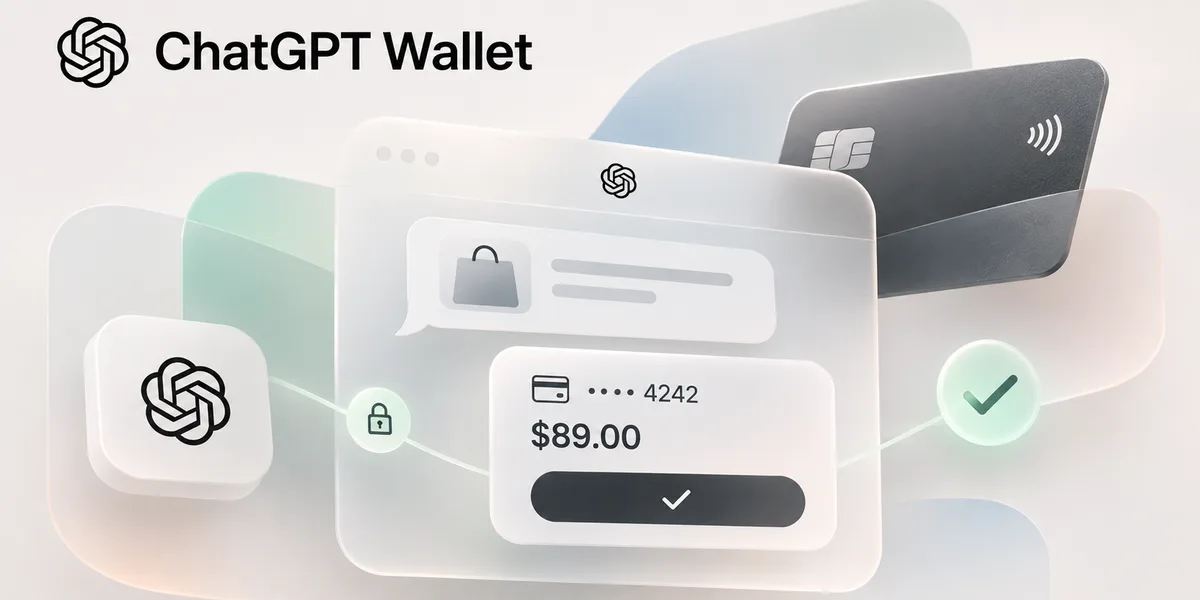
The Wallet works inside what OpenAI calls dots, the agents it introduced at its developer conference in late September. For now it is narrow: ChatGPT Pro subscribers in the United States, aged 18 and over, with eligible cards issued in the US. OpenAI built it with American Express, Chase, Mastercard and Visa.
Three things define it. The agent never holds the card: OpenAI calls it the first wallet that lets agents pay “without access to users’ actual card details”, and the shop receives a network token in place of a card number. Every purchase is approved by the person, with a security check such as Face ID or a fingerprint. And OpenAI told CNBC it is not taking a cut of transactions to start.
Fully delegated buying, with limits set in advance, is a stated plan and not a feature: “Over time, we expect users to be able to delegate purchases entirely to their agent.” No retailer has been named as a launch partner, because none is needed.
The agent pays at your checkout
This is the second attempt. In September 2025 OpenAI launched Instant Checkout, where the purchase happened inside the chat and each merchant had to be connected. It was wound down in March 2026. CNBC reported that about 30 Shopify merchants were live, and that Walmart saw conversion three times lower for purchases inside ChatGPT than for visitors who clicked through to its own site.
The Wallet goes the other way. In the words of OpenAI’s documentation, it “works out of the box with existing checkout pages and payment forms” and “no Wallet-specific integration is required.” The agent opens your site in a browser that runs in OpenAI’s cloud, finds the product, fills in the form and pays with the token.
For the shop the terms are better than in most marketplaces. OpenAI’s announcement says users transact directly with businesses, which keep their customer relationships and control over pricing, fulfillment, returns and customer service. You are the seller, the order is in your system, and the customer’s address is in your database.
Where the purchase breaks
If nothing has to be built, what can go wrong? Two things, and OpenAI names both.
The first is the front door. A browser that runs in a data center, moves quickly and never wiggles the mouse looks like exactly what security tools are trained to stop. The first item on OpenAI’s checklist for shops is to check whether your CDN or firewall blocks verified ChatGPT browser visits. Those visits are signed: each request carries a cryptographic signature under an open standard, HTTP Message Signatures, so a site can tell the real agent from something pretending to be one. According to OpenAI, Akamai, Cloudflare, HUMAN and Vercel verify the signatures automatically. Behind anything else, someone has to set it up.
The second is the payment. OpenAI’s own announcement warns that “risk systems may still flag legitimate purchases made by agents, leading to declines or cancellations.” The fraud decision stays with the shop and its payment provider. A rule that declines any order placed from a data center address will decline this customer every time.
There is a third, quieter failure: a checkout the agent cannot finish. A CAPTCHA at the payment step, a required account, a shipping price that appears only after three screens, a field that works only with a mouse. People put up with these. An agent gives up and buys from the next shop.
Being found comes before being paid
The agent can only buy from a shop it knows. Product results in ChatGPT are not ads; OpenAI says merchants are ranked by things like availability, price and quality. Shops on Shopify are already included through Shopify’s catalog. Everyone else can send a product feed.
The feed is modest: a file in CSV, TSV or JSONL with eleven required fields, among them the title, description, address of the product page, brand, image, price and availability. It is submitted through OpenAI’s Business Hub after identity verification, as an upload, a hosted file or over SFTP. The documentation gives no refresh interval, only the instruction to update availability when an item sells out or comes back. An agent that tries to buy something that is gone has wasted its owner’s approval.
The feed is not the only way in. ChatGPT also reads the web with its own crawlers, and the robots.txt file decides which. OAI-SearchBot is the one behind search answers: block it and the site drops out of them. GPTBot collects data for training, and blocking it does not affect search. A rule added in a hurry two years ago may still be there.
On WooCommerce the picture is mixed. WooCommerce’s own page on agentic commerce lists agent payments through Stripe’s Link as live, and support for the two shopping protocols, Stripe’s and Google’s, as coming soon. It does not mention ChatGPT. Product feeds for ChatGPT come from third-party plugins. None of this stops the Wallet, which only needs a checkout that takes cards.
Not everyone is opening the door
The largest sellers are deciding whether they want this customer at all. CNBC reported in March that Amazon had blocked dozens of AI agents, ChatGPT’s among them, while building its own. This month United Airlines barred unauthorized AI agents from booking or changing tickets on its site. Their reasoning is easy to follow: a company that owns the customer’s attention does not want an agent standing in between.
A small shop has the opposite problem. It does not own the customer’s attention, and an agent that compares twenty shops on price, delivery time and returns is the fairest hearing it will ever get. Blocking agents is a strategy for whoever is already the default choice.
How big this is today
Small, and worth saying plainly. The Wallet is limited to one plan in one country. TechCrunch reported on launch day that DoorDash had seen only a few hundred orders placed by agents, and that Uber sees almost none. The earlier attempt was closed for lack of use.
What is already large is the step before the purchase. Adobe, which measures more than a trillion visits to US retail sites, forecasts that visits arriving from AI assistants will rise 130% year on year this holiday season. People ask the assistant what to buy and then go and buy it themselves. ChatGPT has, by OpenAI’s count, more than 1.2 billion weekly users. The research already happens there; the Wallet is an attempt to move the last step there as well.
What to do this quarter
- Open your robots.txt. Make sure OAI-SearchBot is not blocked, and decide about GPTBot on purpose. Do the same check for the other assistants you care about.
- Ask whoever runs your firewall or CDN one question: are verified AI agent visits let through, or challenged? On the large networks OpenAI lists, the check is automatic. On a smaller host it may be a support ticket.
- Walk through your own checkout as a guest. Can an order be placed without an account, with the full price including delivery visible before payment, and without a puzzle at the last step?
- Keep stock and prices true on the page. The agent reads what the page says. A product shown as available that is not costs you the sale and the next one.
- Put the answers in text. Delivery time, return terms, sizes, compatibility, what is in the box. An agent comparing shops for its owner picks the one where it does not have to guess.
- Talk to your payment provider about how orders from agents are scored, before the first one is declined.
- If you sell to the US, prepare a feed. If you do not, wait: most of the fields are ones a Google Merchant Center feed already has, and nothing is lost by sending it later.
What is still unknown
Two questions have no answer yet. One is who pays when the agent buys the wrong thing. OpenAI says only that users keep their card’s existing protections for eligible disputes with businesses. In practice a dispute reaches the shop like any other card dispute, so clear product pages and a clear returns policy are the defense. The other is Europe. There is no date for the Wallet outside the United States, and European payment law has no rules written for agents; lawyers who follow it say the existing directive applies for now.
None of the homework above depends on those answers. A shop that an agent can read, enter and pay at is also a shop that is easier for a person in a hurry. That part pays off whether or not the agents arrive on schedule.




 Any questions? Let's talk!
 Write to us,